About (Edit profile)

This author has not yet filled in any details.
So far has created 1829 blog entries.

Our Shared Responsibility: Africa’s Cybersecurity Imperative Francine Katsoudas on July 22, 2024 at 7:01 am

We have a shared responsibility to embed cybersecurity at the core of our digital strategies, and we look forward to the opportunity to enhance cyber resilience in Africa—a continent on the brink of a remarkable digital transformation.

​[[{"value":"

Globalization and digitization have made our world progressively interconnected, and as the promise of AI is realized around the world, so are accompanying threats. Cybersecurity stands as a critical pillar for economic stability and growth, reaching across borders and touching every aspect of our global community, but Cisco’s Cybersecurity Readiness Index reveals a sobering truth: that a mere 3% of global organizations are ready to address contemporary risks across the full spectrum of cybersecurity solutions. As a testament to that data point, last year there were nearly 3,000 publicly disclosed data breaches—impacting businesses, citizens, public services, and more.

This gap in cyber readiness is an inherent risk to the entire world’s digital ecosystem, and it urgently underscores the need—and our shared responsibility—to strengthen our interconnected defenses. By embedding cybersecurity in global digital strategies and building a robust cybersecurity workforce, we can realize the promise of AI and make sure no one gets left behind. Nowhere is the need for cyber resiliency more evident than in Africa—a continent on the brink of a remarkable digital transformation.

Africa’s Digital Transformation and Cybersecurity Imperative

Technology has emerged as a powerful engine for economic growth in Africa where GDP has increased more than fivefold in just two decades. The explosive growth is driven by increased internet usage, mobile banking, and AI-driven innovation that does everything from predicting climate changes to improving maternal health. Continued growth is projected to drive Africa’s GDP to over $4 trillion by 2027. Yet, the concerning reality remains that 60% of Africans are unconnected and the advancements of the global economy are out of reach for many.

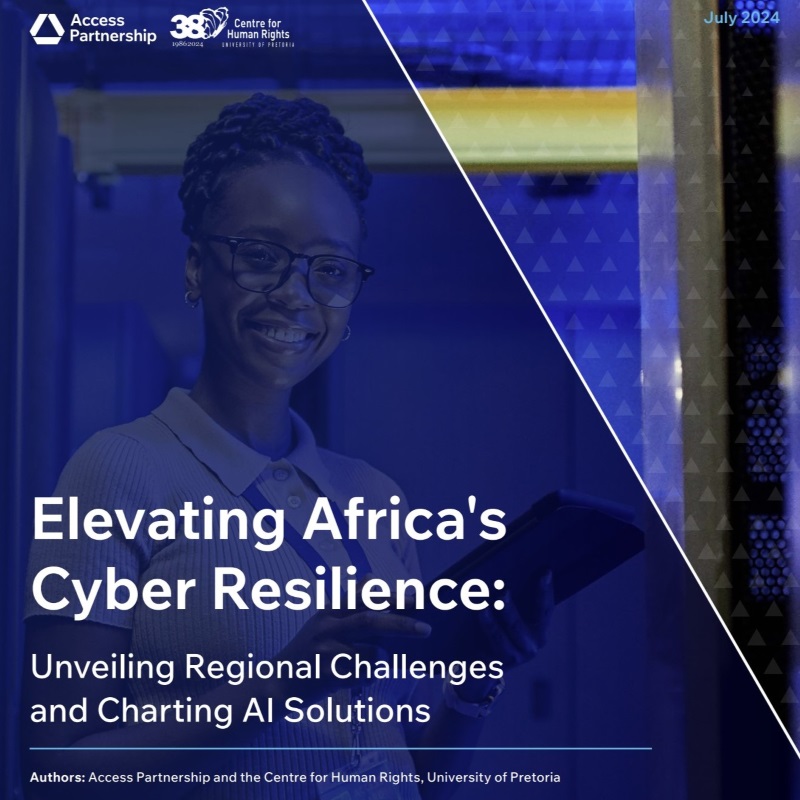
The path to enhancing Africa’s cyber resilience, and that of the wider world, is a collective journey. As we connect the next billion users, we’re calling on governments, businesses, and civil society to delve into the insights provided by Access Partnership and the Centre for Human Rights at the University of Pretoria in their report: “Elevating Africa’s Cyber Resilience: Unveiling Regional Challenges and Charting AI Solutions.”

In the second quarter of 2023, Africa witnessed the highest average number of cyberattacks per week per organization — a 23% increase compared to the same period in 2022.
In 2023, attackers used malware in four out of every five successful attacks on organizations, and one in two reported incidents involved social engineering.
Only 28% of countries in Africa have ratified the Malabo Convention — the African Union’s cybersecurity protocol. Implementing existing frameworks and harmonizing risk-based approaches would help improve the effectiveness of cybersecurity measures.
Technologies like encryption and cryptography which safeguard data are especially helpful across Africa where there are limited data protection frameworks.
Cloud computing, which can enable consolidation of cybersecurity controls across applications and networks, offers advantages for scaling limited resources.

The report conveys how securely unlocking Africa’s vast potential starts first with connecting the 700 million people that are still offline across the continent. But it’s not enough to just connect. We must also protect. By harnessing human intelligence alongside advanced AI and cybersecurity tools, we can decisively tip the balance in favor of those who defend our digital spaces and pave the way for a future where technology and infrastructure are inherently secure. To seize this opportunity, we must also invest in people.

Cultivating Cybersecurity Talent for Economic Empowerment

The entrepreneurial spirit that fuels innovation from Cairo to the Cape is the same one needed to fortify cybersecurity across the continent’s diverse economies. A new generation of cyber professionals will be instrumental in analyzing cybercriminal tactics, identifying perpetrators, and crafting preventative measures that make our systems safer and more reliable. With the wealth of untapped talent in Africa, there is an opportunity to cultivate a diverse and inclusive workforce that blends technical acumen with creative problem-solving.

My optimism lies in the ripple effect that will occur by expanding the cybersecurity field in Africa. It’s not just about job creation, it’s about opening doors to meaningful remote careers that offer significant prospects for economic advancement while helping people stay in and support their communities. The need to uplift and sponsor women in Africa is especially crucial as they face stark disparities in access to digital technologies and as a result, are often sidelined in the digital economy. With women making up only 9% of cybersecurity professionals on the continent as of 2021 compared to the 25% globally, fostering inclusive growth opportunities is an imperative.

Collaboration for a Secure Digital Future

I recently had the honor of reinforcing Cisco’s commitment to Africa in a big way with the launch of our Cybersecurity Experience Center in Nairobi. It’s also a proud privilege to see everything Cisco Networking Academy in Africa has accomplished—empowering 1.5 million learners in Africa including over 460,000 women and setting a goal to train 3 million more on the continent. Skilling is a critical component in digital transformation and a pathway to participation.

During this work, and in all my conversations with African leaders and communities, one truth resonates: cybersecurity is not an optional luxury; it is a necessary foundation for a stable and prosperous economy. It safeguards our data, our privacy, and our means of living so that we can innovate and elevate – unimpeded by the shadow of cyber threats. As we chart our future—and help customers, communities and countries do the same—digital resiliency is essential for full participation in the global economy and a fundamental part of an inclusive future for all.

Read the Access Partnership Report:

Share

"}]]  We have a shared responsibility to embed cybersecurity at the core of our digital strategies, and we look forward to the opportunity to enhance cyber resilience in Africa—a continent on the brink of a remarkable digital transformation.  Read More Cisco Blogs 

By |2024-07-22T07:52:53+00:00July 22, 2024|Cisco: Learning|0 Comments

Boardroom Focus: Communications Compliance Stephanie Feliciano on July 19, 2024 at 7:06 pm

Cisco Webex in collaboration with a partner provides a compliance and security solution tailored for digital communications within the Webex Suite, serving major organizations like top North American banks.

​[[{"value":"

Communications Compliance is Taking Center Stage in the Boardroom

Within the modern governance landscape in financial services, communications compliance has emerged as a critical issue, spurred by the staggering fines for unmonitored communications that have surpassed $2 billion USD in the United States alone. In February 2024, an additional 16 firms faced SEC fines totaling $81 million, signaling a zero-tolerance stance by regulators against compliance violations.

The Cisco and Theta Lake partnership, established in 2018, reflects a strategic response to these challenges. Theta Lake enhances the security and compliance features of Cisco’s Webex collaboration suite. This joint solution ensures institutions can safely harness the power of Webex’s functionalities, while significantly reducing the risk of penalties, increasing user satisfaction, and enhancing ROI (return on investment).

Theta Lake’s “Digital Communications Governance, Compliance, and Security Survey” for 2023/24, sheds light on the evolving landscape. With independent responses from over 600 IT and compliance professionals, the Theta Lake report reveals that 40% of firms have now elevated communications compliance to a board-level concern, underscoring the pressing demand for a revamped compliance and security framework for Unified Communications and Collaboration (UCC) tools that are integral to the modern workplace.

Why Are Firms Reevaluating Their Communications Compliance Strategies?

The survey indicates a widespread reassessment of communications compliance strategies in financial services, with 77% of respondents revising their approaches, 17% planning to do so, and 45% considering a complete overhaul. Traditional methods often fail to seamlessly capture, retain, and supervise across diverse communication platforms, leading to inefficiencies and compliance lapses. To counter these challenges, organizations are restricting key features that users want and need, inadvertently pushing employees towards unmonitored channels.

Theta Lake, in partnership with Cisco Webex, offers a purpose-built compliance, supervision, and security solution that integrates seamlessly across the Webex Suite, whether content is displayed, shared, spoken, or written. This solution brings significant value to leading organizations, including some of Webex’s largest customers—six of the top ten North American banks.

Where Should Organizations Begin When Overhauling Their Digital Communications Strategy?

Addressing compliance complexities requires a structured, proactive approach. In a rapidly evolving digital landscape, organizations must anticipate regulatory expectations and strategically overhaul their digital communications governance.

Cisco and Theta Lake recommend a three-point strategy:

Effective Data Capture: Accurate and reliable record keeping starts by capturing the correct data at its source, along with its context and time of origin. This step is crucial for reconciliation and reporting.
Record Navigation: With comprehensive record keeping across various channels, searching and navigating records and their interwoven communications becomes both possible and efficient.
AI-Enhanced Compliance Scaling: AI (Artificial Intelligence) technology, specifically tailored for compliance, helps manage and oversee vast amounts of communication records, enabling institutions to identify and mitigate risks and maintain robust compliance standards.

Theta Lake: A Cisco SolutionsPlus Partner

The Cisco SolutionsPlus program features tested Cisco Compatible products. As a SolutionsPlus partner focused on collaboration and security, Theta Lake’s solution for the Webex Suite is available for purchase through the Cisco price list. This includes fully compliant capture, archiving (in existing systems or Theta Lake’s SEC-17a-4 compliant environment), and built-in policy-based AI-enabled risk detection/remediation/redaction capabilities for:

Webex Calling & Customer Experience Essentials (New!): Voice Recordings, Business Texts (SMS), and Call Detail Records.
Webex Meetings & Selective In-Meeting Communications: Video recordings, and selective archiving of any or all meeting components including audio or in-meeting eComms (such as chat, polling, Q&A, transcripts, and closed captioning).
Webex Messaging: All content, replies, and reactions—including files and rich media (like images and GIFs).
Polling/Slido: All content including polls, Q&A, surveys, and more.
Webex Connect: Archiving & supervision support of log exports via SMTP or Rest API for SMS and omnichannel content.

In an era of intense regulatory oversight, Cisco and Theta Lake’s joint solutions have transitioned from a strategic asset to an essential requirement for financial services organizations aiming to ensure robust communications compliance.

The full Theta Lake “Digital Communications Governance, Compliance, and Security Survey“ 2023/24 can be downloaded here and check out our Portfolio Explorer for more information on the use cases that Cisco supports in the Financial Services industry.

Share

"}]]  Cisco Webex in collaboration with a partner provides a compliance and security solution tailored for digital communications within the Webex Suite, serving major organizations like top North American banks.  Read More Cisco Blogs 

By |2024-07-20T05:50:00+00:00July 20, 2024|Cisco: Learning|0 Comments

Cisco Live U.S. Industrial IoT Summit Wrap Up: AI, Innovation, and Cybersecurity Bryan Tantzen on July 18, 2024 at 7:00 pm

CLUS Industrial IoT Summit top customer concerns were cybersecurity, the IT/OT workforce gap, and the urgent need to modernize networks in the age of AI.

​[[{"value":"

It’s been a few weeks, but I’m still thinking about the excitement coming out of Cisco Live U.S. in June. We hosted our second annual Cisco Live U.S. Industrial IoT Summit and had our largest attendance to date. Leaders from across the manufacturing, utilities and transportation industries came together to share knowledge, discuss technology trends and challenges, and connect with each other in industry breakout sessions.

Discussions were eye opening, and we heard directly from customers across the Industrial IoT space about their top-of-mind priorities. Many told me how valuable it was to engage in high-level dialogue with their peers: simply knowing they are not alone and face similar challenges was a comfort.

Insights from the Industrial IoT Summit

Cybersecurity remains a top priority. In a pre-event survey, leaders across all verticals told us that, like last year, cybersecurity remains their top priority. As systems become more integrated and connected and attack surfaces increase, organizations are seeking ways to gain OT network visibility, ensure secure remote access, and segment their operational networks. I talked to several customers who also hope to automate security enforcement or add zero-trust capabilities across their industrial networks, which underscores the importance of designing a secure network architecture from the ground up.

The workforce skills gap is a major concern. Across the Industrial IoT landscape, customers are finding it difficult to hire and retain the right talent who understands both OT and IT environments and can drive collaboration between the two. Many asked about how we can leverage technology and automation to help. Upskilling and investing in workforce development is critical, and we heard directly from a university partner about how they’re bridging IT/OT through a partnership with Cisco Networking Academy to train students in new IT/OT skills and help agencies hire and nurture talent.

Networks must be modernized to prepare for the future. Of course, there was a lot of energy and discussion around how AI is driving innovation and optimization across Industrial IoT. Digitization is increasing across all industry verticals, and virtualization of key technology components is now a reality. Mobility was also top-of-mind as more industries look to deploy wireless technologies as part of modernizing their networks. The discussion also focused on how increasing secure and resilient access to data in industrial edge devices, assets and applications is critical.

Each of our breakout summit discussions offered meaningful takeaways as well. Read on for more insights from the different Industries!

Manufacturing Breakout: Key Takeaways

Reliable wireless connectivity is critical for productivity. Major manufacturers need dependable, always “on,” lossless wireless technologies, and demand is only rising. Reliable connectivity with Wi-Fi remains a challenge, but our Industrial Wireless Solutions with Ultra-Reliable Wireless Backhaul are enabling customers to support use cases around mobile devices and autonomous vehicles like AGVs that require reliable low-latency and zero-packet loss connectivity, despite obstacles and RF interference.

Smart manufacturing innovations require an equally smart network. As factories modernize, maintaining a secure, resilient network can mean the difference between a normal day or a catastrophic shutdown costing a manufacturer millions of dollars. A scalable, flexible, secure, and deterministic network is essential for innovations like hardware resource virtualization, zero-trust security, and AI-enabled manufacturing applications.

We heard from one major manufacturer about how Cisco’s architecture is enabling safe, reliable data collection to help them develop AI and ML models that make recommendations to optimize production, drive process control, support preventative maintenance, and enable data-driven manufacturing. We also heard from an EV battery manufacturing customer who uses AI and ML to produce one of the greenest, most sustainable EV batteries on the planet at a 70% reduction in carbon per battery made compared to its competitors.

Utilities Breakout: Key Takeaways

There is a major shift happening toward grid modernization. Energy demand is growing, and utilities organizations need to integrate sustainability practices at scale while also enhancing security, efficiency and reliability. To meet these needs, modernizing the power grid and the distributed architecture they rely upon is key.

Grid resiliency and security is critical. Customers told us they feel an urgency to accelerate cybersecurity measures to keep critical power infrastructures safe, provide access for technologies like 5G and eSIMs, and find scalable network management and automation tools to minimize downtime and drive efficiency. Utilities companies face challenges in the management of backhaul communications and need help streamlining these operations. We also discussed how the war in Ukraine has highlighted the importance of critical infrastructure grid resiliency in the most adverse of conditions.

We talked about the potential for SD-WAN with Cisco Catalyst Industrial Routers to secure and scale grid infrastructure with comprehensive firewalls, especially given the rapidly evolving threat landscape and increasing sophistication of attacks. SD-WAN offers a solution for zero-touch provisioning and the ability to standardize security policies across all routers in the field, which minimizes the potential for human error and configuration issues.

Transportation Breakout: Key Takeaways

Transportation network modernization is essential. As billions of citizens and tons of cargo are moved daily to support the modern economy, technology drives the critical infrastructure that supports it; yet the transportation vertical has one of largest technology debts across Industrial IoT. Many of these systems are funded by the public, however; and budgets are tight. Agencies feel an urgency to simplify, modernize and achieve a better digital footprint at scale, but they must make practical investment decisions and choose the right networking infrastructure that is secure, scalable, and simplified.

Cybersecurity is at a critical point and is rising to the C-Suite. OT visibility and access remain major challenges across the transportation sector as DOTs, cities and countries modernize their networks with Intelligent Transportation Systems (ITS). I heard from customers that they’re looking to make the right investments amid increased cyberattack surfaces, external regulatory pressures, and cybersecurity mandates like CISA and Europe’s NIS2.

AI will transform how cities, railroads, airports, and DOTs interact with the population. We heard from a public transportation customer who shared some of the ways that AI will enable them to enhance citizen safety by predicting traffic patterns, reducing travel times, increasing automation, and engaging in predictive maintenance to prevent major accidents like train derailments. But to reap these benefits, organizations need to invest in secure, well-managed networks that can eventually handle a massive amount of data across the edge, core, and cloud to drive AI and ML.

Adopting SD-WAN dramatically increases efficiency and security. Traditional IT environments have embraced SD-WAN for years to reduce access charges, increase reliability, reduce issue resolution time, and gain richer visibility into WAN operations. Now, some of our OT customers are adopting Cisco Catalyst SD-WAN. We heard from a rail customer who relies on Cisco Catalyst SD-WAN as a solution for their operational areas to power evolving connectivity needs, improve visibility, save money, and improve automation. They shared how embracing SD-WAN has made it easier to manage mission-critical traffic and segment their networks while also driving better IT and OT collaboration across its operations.

Our customers are our partners. Bringing together industry leaders to collaborate and dive into the challenges and innovations shaping the future of Industrial IoT was such a fantastic experience, and the summit’s discussions underscored the urgency of adopting advanced technologies to protect and connect our customers across all Industrial IoT sectors. As industries strive to modernize their networks and prepare for a more connected and data-driven future, we know we would not be able to provide solutions without the trust of our customers. Together, we will make progress and securely make the future a reality!

Share

"}]]  CLUS Industrial IoT Summit top customer concerns were cybersecurity, the IT/OT workforce gap, and the urgent need to modernize networks in the age of AI.  Read More Cisco Blogs 
By |2024-07-19T04:59:31+00:00July 19, 2024|Cisco: Learning|0 Comments

Zscaler Delivers New ChatGPT Enterprise Compliance API Integration to Drive User Productivity Steve Grossenbacher

Generative AI (GenAI) has tremendous potential to transform how users [...]

By |2024-07-18T22:56:20+00:00July 18, 2024|Zenith: Zscaler|0 Comments

Breaking through barriers: Upwardly Global helps work-authorized immigrants secure meaningful U.S. employment Julie Rose on July 18, 2024 at 7:13 am

Cisco NGO partner Upwardly Global elevates U.S. immigrants who are searching for quality employment that matches their professional skills and experience. Our latest grant supports AI development to help streamline and improve the job search process.

​[[{"value":"

As Cisco’s commitment to our purpose to power an inclusive future for all drives us forward, we continue expand how we use our technology, our people, our resources, and our networks to address inequities and open more opportunities for more people.

To power this kind of future, we work closely with nonprofit partners who provide people with equitable access to the knowledge, skills, and resources needed to support themselves and their families toward long-term resilience and economic security – partners like Upwardly Global.

Breaking down systemic barriers to employment for immigrants and refugees

Job seekers receiving career coaching

More than two million highly skilled immigrants, refugees, and asylees with work authorization live legally in the U.S. but can’t find jobs that match their skills and experience. At the same time, the U.S. workforce faces an acute labor shortage, particularly in the STEM and healthcare sectors. These engineers, healthcare workers, and other professionals meet necessary criteria to help fill these positions, yet systemic barriers to employment make it challenging for immigrants to find work. They may lack the necessary tools to efficiently search for a job, speak English as their second language, have a small network, or may be unfamiliar with U.S. workplace language and culture.

As a result, highly skilled immigrants continue to remain underemployed in lower-paying jobs such as rideshare drivers or maintenance. Upwardly Global helps these job seekers understand and navigate the U.S. job market to re-engage with their professional careers. By seeking employment that aligns with rather than neglects their skills, immigrants can acquire stable and sufficient familial income, access future development opportunities, and contribute to their communities and the economy.

The social and economic impact of addressing inequities and bridging gaps is substantial. In 2023, the average starting salary of job seekers who completed Upwardly Global’s Career Coaching Program was $64,000 – a $50,600 annual salary gain. Together, the immigrants and refugees who completed the program in 2022 now contribute $74 million annually to the U.S. economy.

Career coaching builds a strategic path

Upwardly Global’s program provides job seekers with an experience that starts with education and ends with hiring, focused through an industry-relevant lens. Members begin their journey by pairing with a career coach who helps with building a strategic job-search path toward their desired career. Regular meetings help job seekers improve their professional English skills, which proves useful in both job interviews and communication within the U.S. workplace environment.

Members are also given access to eLearning resources where they can expand on or complement their skillsets. And when they begin the job search process, members learn how to use professional websites like LinkedIn and work with their coaches to grow their confidence and soft skills, both of which can diminish while integrating into a new and unfamiliar culture. Networking events, volunteering, and mentorships allow members to practice their skills while planting the seeds of their new, digital network. Further support in resume creation and interview preparation sets clients on a sturdy path towards their next opportunity.

AI: The employment game changer

Upwardly Global jobseeker

In 2020, Cisco began supporting Upwardly Global as part of our larger One Billion Lives goal, created to positively impact one billion individual lives by 2025 through investing in nonprofit tech-based solutions (which we achieved over a year early in 2023).

Since the beginning of our involvement with Upwardly Global, AI has triggered a drastic shift in the U.S. job market across all unemployed individuals, with immigrants coming out at a greater disadvantage. A recent Stanford study on GPT-generated text found that 98 percent of content written by nonnative English speakers was falsely flagged as AI-generated. With companies now using AI to sort between qualified and unqualified candidates, immigrants face a tough new barrier to surmount during their job search.

In 2021, Upwardly Global released their AI job pathways tool, which provides a faster way to plan and execute job searches. Upwardly Global’s newest round of funding from Cisco will enable them to pilot and integrate two new AI upgrades that continue to transform the job search process: a career navigation assistant that can map out career paths, and an AI-powered resume and cover letter builder to strengthen applications before being submitted to recruiters. Piloting this new tool with current clients is paramount in helping Upwardly Global to develop a user-centric model that reflects the needs of the immigrant community. Upon integration, Upwardly Global expects that these new tools will help job seekers move through their program more quickly, providing quality income earlier and allowing Upwardly Global to help more individuals overall.

“Upwardly Global consistently empowers newcomer communities, thanks to our impactful partnerships. Our support from Cisco serves as a bedrock, supporting newcomers with cutting-edge resources essential for their professional success.”—Jina Krause-Vilmar, Upwardly Global President and CEO

Social impact

Anastasiia, an HR manager from Ukraine

In addition to continued support from Cisco, Upwardly Global also partners with the U.S. Office of Refugee Resettlement and was recently featured in a report by the Department of Labor. The nonprofit’s overall success includes over 11,000 job placements to date, with a total 2023 economic impact of US$74 million. Following are just two examples of how Upwardly Global has helped thousands of U.S. immigrants, refugees, and asylees pursue meaningful work:

Anastasiia, an HR manager from Ukraine, held two master’s degrees and was an HR manager before she was forced to flee to New York with her son. Eager to find new work, she was hired as an IT recruiter after one month in the Upwardly Global Career Coaching Program.
Vanessa, a Venezuelan anesthesiologist, fled her home country with family to New York. She could not find relevant work, and her family struggled for five years to earn a living. After connecting with Upwardly Global, Vanessa found a job at a New York hospital as a senior anesthesia technician.

Upwardly Global’s impact on people trying to build a new life in the United States is impressive. Partnering with nonprofits like Upwardly Global means we can together multiply our impact and help vulnerable people in the U.S. and around the world achieve stability, resilience, independence, agency, and economic security.

With every person our nonprofit partners impact and every connection we make, we continue to advance Cisco’s purpose to power an inclusive future for all.

For more information:

Learn more about how Cisco achieved our One Billion Lives goal on our website
Read more about Upwardly Global’s work and inspiring stories of success from immigrants and refugees getting back to work in their chosen fields.
AI for Impact: How To Thoughtfully Leverage Technology To Deliver on Mission

Share

"}]]  Cisco NGO partner Upwardly Global elevates U.S. immigrants who are searching for quality employment that matches their professional skills and experience. Our latest grant supports AI development to help streamline and improve the job search process.  Read More Cisco Blogs 

By |2024-07-18T16:50:37+00:00July 18, 2024|Cisco: Learning|0 Comments

Discovering Entrepreneurship with Cisco Networking Academy Rebeca De La Vega on July 18, 2024 at 12:00 pm

Cisco Networking Academy launches Discovering Entrepreneurship to help ignite the entrepreneurial spirit across Latin America. ¡Despierta el espírtu emprendedor en ti!

​[[{"value":"

Cisco Networking Academy is launching a new course, Discovering Entrepreneurship. In the spirit of encouraging and fostering entrepreneurship, here is how we plan to encourage people with a business idea to turn their dream into reality in Latin America.

Entrepreneurship: The big picture

When we talk entrepreneurship, most would think of the tech billionaires we know as household names. But to do so is to diminish the role that smaller – but still successful – entrepreneurs play in the development of regions like Latin America.

According to the Center for Strategic and International Studies1, “The start-up ecosystem in LAC is having a considerable impact in the region, catalyzing a generation of innovators to increase competitiveness and economic growth.”

It is encouraging that startups in the region often address issues such as financial inclusion, that promote digitization, or improved healthcare, and climate solutions.

According to the World Bank2, four of every 10 Latin American youth report a desire to become an entrepreneur.

A less encouraging report from the Organisation for Economic Co-operation and Development3 suggested that entrepreneurial activity in the region is more associated with lack of other employment alternatives for young people.

To be fair, both these things can be true. But the demand from education institutions for entrepreneurship courses suggests they may be helpful in both cases: by encouraging entrepreneurial activity and the economic growth it brings; and by helping young people be successful in their entrepreneurial activity.

Developing an entrepreneurial mindset

The entrepreneurial mindset is valuable to existing companies too. One recent study4 argues that entrepreneurs possess execution skills uniquely suited for taking new ideas to market. These skills are valuable beyond the start-up context and can be deployed by established firms, particularly to launch new products and services.

Indeed, the entrepreneurial mindset is at the core of Cisco – a company founded by Len Bosack and Sandy Lerner in 1984. The two were not able to email each other from their respective offices at Stanford University because they were on different networks with different local area protocols. They solved this problem by inventing the multiprotocol router. And Cisco was born.

What started by simply solving a problem may have grown into a global corporation, but the innovation skills of those founders continues to be encouraged and fostered at Cisco.5

Discovering Entrepreneurship

In the spirit of encouraging and fostering entrepreneurship, Cisco Networking Academy is launching a new course, Discovering Entrepreneurship.

This 20-hour course is the first in a three-part entrepreneurship series, designed to teach the fundamentals of entrepreneurship and develop a solution-oriented approach to problem solving in the workplace.

The Discovering Entrepreneurship course has no prerequisites beyond a high school reading level, basic computer literacy and internet usage skills and is available in English and Spanish. As such, we encourage anyone with an idea to use Discovering Entrepreneurship to get started and begin turning their dreams into reality.

Register today!

Whether you are an aspiring entrepreneur with the next big idea, or you want to sharpen your problem-solving entrepreneurial skills and improve your employability, don’t wait!

Discovering Entrepreneurship

For Educators

Exclusive to Cisco Networking Academy Instructors in Latin America

We are excited to offer Cisco Networking Academy educators in Latin America the opportunity to teach Discovering Entrepreneurship courses and participate in our campaign and prize competition:  Bring Out the Entrepreneur in You / Despierta el espírtu emprendedor en ti.

Educators who enroll the highest number of student participants can win some great prizes!

Join us in igniting the entrepreneurial spirit across Latin America through our campaign, “Despierta el espírtu emprendedor en ti” — available for a limited time only. Start teaching today!

Educators, enter the competition

Want to join 29,000+ educators around the world? Teach with us atCisco Networking Academy for Educators.

Sources

1  Center for Strategic and International StudiesCatalysts of Change: How Entrepreneurs Are Transforming Latin America

2  World Bank – Entrepreneurship is the trend in Latin America

3  Organisation for Economic Co-operation and Development (OECD) – OECD/CAF/ECLAC (2016), Latin American Economic Outlook 2017: Youth, Skills and Entrepreneurship, OECD Publishing, Paris 

4  Universitat Pompeu Fabra, BarcelonaHiring entrepreneurs for innovation (Economics Working Paper Series, Department of Economics and Business, Working Paper 1811)

5  Cisco Newsroom – Why this Cisco leader believes every employee can build our boldest innovations

Share

"}]]  Cisco Networking Academy launches Discovering Entrepreneurship to help ignite the entrepreneurial spirit across Latin America. ¡Despierta el espírtu emprendedor en ti!  Read More Cisco Blogs 
By |2024-07-18T16:50:36+00:00July 18, 2024|Cisco: Learning|0 Comments

Introducing the Coalition for Secure AI (CoSAI) Omar Santos on July 18, 2024 at 3:00 pm

Announcing the launch of the Coalition for Secure AI (CoSAI) to help securely build, deploy, and operate AI systems to mitigate AI-specific security risks.

​[[{"value":"

Today, I am delighted to share the launch of the Coalition for Secure AI (CoSAI). CoSAI is an alliance of industry leaders, researchers, and developers dedicated to enhancing the security of AI implementations. CoSAI operates under the auspices of OASIS Open, the international standards and open-source consortium.

CoSAI’s founding members include industry leaders such as OpenAI, Anthropic, Amazon, Cisco, Cohere, GenLab, Google, IBM, Intel, Microsoft, Nvidia, and PayPal. Together, our goal is to create a future where technology is not only cutting-edge but also secure-by-default.

CoSAI’s Scope & Relationship to Other Projects

CoSAI complements existing AI initiatives by focusing on how to integrate and leverage AI securely across organizations of all sizes and throughout all phases of development and usage. CoSAI collaborates with NIST, Open-Source Security Foundation (OpenSSF), and other stakeholders through collaborative AI security research, best practice sharing, and joint open-source initiatives.

CoSAI’s scope includes securely building, deploying, and operating AI systems to mitigate AI-specific security risks such as model manipulation, model theft, data poisoning, prompt injection, and confidential data extraction. We must equip practitioners with integrated security solutions, enabling them to leverage state-of-the-art AI controls without needing to become experts in every facet of AI security.

Where possible, CoSAI will collaborate with other organizations driving technical advancements in responsible and secure AI, including the Frontier Model Forum, Partnership on AI, OpenSSF, and ML Commons. Members, such as Google with its Secure AI Framework (SAIF), may contribute existing work in terms of thought leadership, research, best practices, projects, or open-source tools to enhance the partner ecosystem.

Collective Efforts in Secure AI

Securing AI remains a fragmented effort, with developers, implementors, and users often facing inconsistent and siloed guidelines. Assessing and mitigating AI-specific risks without clear best practices and standardized approaches is a challenge, even for the most experienced organizations.

Security requires collective action, and the best way to secure AI is with AI. To participate safely in the digital ecosystem — and secure it for everyone — individuals, developers, and companies alike need to adopt common security standards and best practices. AI is no exception.

Objectives of CoSAI

The following are the objectives of CoSAI.

Key Workstreams

CoSAI will collaborate with industry and academia to address key AI security issues. Our initial workstreams include AI and software supply chain security and preparing defenders for a changing cyber landscape.

CoSAI’s diverse stakeholders from leading tech companies invest in AI security research, shares security expertise and best practices, and builds technical open-source solutions and methodologies for secure AI development and deployment.

CoSAI is moving forward to create a safer AI ecosystem, building trust in AI technologies and ensuring their secure integration across all organizations. The security challenges arising from AI are complicated and dynamic. We are confident that this coalition of technology leaders is well-positioned to make a significant impact in enhancing the security of AI implementations.

We’d love to hear what you think. Ask a Question, Comment Below, and Stay Connected with Cisco Security on social!

Cisco Security Social Channels

InstagramFacebookTwitterLinkedIn

Share

"}]]  Announcing the launch of the Coalition for Secure AI (CoSAI) to help securely build, deploy, and operate AI systems to mitigate AI-specific security risks.  Read More Cisco Blogs 

By |2024-07-18T16:50:35+00:00July 18, 2024|Cisco: Learning|0 Comments
Go to Top