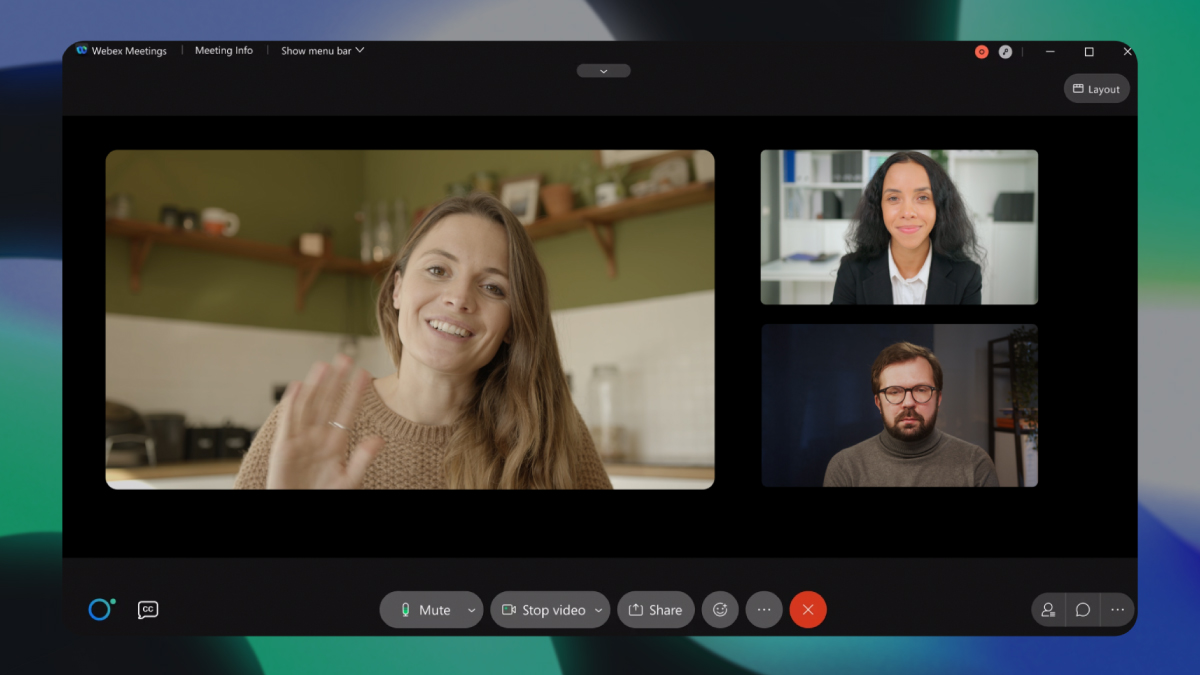
AI and Webex: a game-changing combination Cisco Newsroom: Security
At WebexOne this month, Cisco will unveil new solutions that [...]


At WebexOne this month, Cisco will unveil new solutions that [...]
From New York to Paris, Atlanta to Chicago, Cisco’s cutting-edge [...]
Younger Consumers Are 7 Times More Likely to Exercise their [...]
Cisco’s 2023 Consumer Privacy Survey reveals strong feelings on AI, [...]
This fun, spirited, and engaging conversation explores the life journeys [...]
An interview with Valeria Scribanti, a Technical Solutions Specialist with focus on cybersecurity.
Welcome to the Cisco Women in Cybersecurity’s blog series, where we highlight the stories of the m… Read more on Cisco Blogs
An interview with Valeria Scribanti, a Technical Solutions Specialist with focus on cybersecurity.
Welcome to the Cisco Women in Cybersecurity’s blog series, where we highlight the stories of the mentors who have inspired and advocated for the careers of those in our community. This series seeks to show the importance of allyship, connection, and how different the journeys can be into a career in cybersecurity.
Valeria and I met soon after I joined Cisco in 2021. We are both part of the “Swiss Cybersecurity Women” group, which is an internal online group for women in cybersecurity based in Switzerland. Over the years, Valeria and I stayed in touch, scheduling a virtual coffee or sending each other interesting articles. Last year we even got a chance to meet in person at Cisco Live in Amsterdam. The thing that strikes me about Valeria is her upbeat attitude, energy and tenacity. This interview is a chance for me to find out more about Valeria’s path into cybersecurity and her secret to staying positive in an industry with a tendency to focus on the dark side of affairs.
I’ve always been very interested in technology from a curiosity perspective, even though growing up I did not see myself as a very nerdy person. I’m a millennial, so I grew up in an environment where technology was not all that present. I still remember the first time I saw an iPod; it really fascinated me as a device, and I instantaneously wanted to find out all about its workings. Later, when my father bought his first laptop and he was programming in Visual Studio at home one day, I caught my first glimpse of code and that got me hooked. From there I understood that technology is what I wanted to do, and I decided to enroll first in a bachelors engineering program at Politecnico di Torino and then continue with the double degree master’s program between the Politecnico di Torino and the Hamburg University of Technology (TUHH).
So, it was really about intuition and curiosity which led me to choose technology as a profession. Well, that and the fact that I was playing a lot of Nintendo with my brother.
My studies in Italy laid the foundation for my later work in cybersecurity. As a student in the Computers and Communication Network Engineering program, I got to play with a lot of Cisco technology, learning switching and routing. Yet, as a whole, the university program was rather theoretical and research oriented. It was not until I went to Germany for the exchange program that I took a great course on cybersecurity with a professor from the industry. I was fascinated with the topics he covered in this class – buffer overflow, SQL injections, cross-site scripting. Times have changed nowadays, but back then this type of course was not a standard part of the university curriculum. The topic felt so new and super exciting to me that I decided to consider cybersecurity as a possible direction after graduation.
I landed my first job soon after finishing my master’s degree. The university helped us find a position so for me it was a really smooth transition. The job market back then offered crazy number of opportunities, unlike the current situation.
By doing the interviews I actually got to know more about the different roles, what day-to-day activities they involve and what trajectory I could follow if I were to join.
My first role was a Network and Security Engineer at a system integrator company in Italy. I still remember the interview with them. We started off with some easy to answer questions, such as “what is a firewall?”. The next questions, however, were topics which were totally new to me back then, such as what an IPS (intrusion prevention system) and defense-in-depth etc. Looking back, I think that the interviewers posed those questions to hone my appetite for the topic and demonstrate that they were dealing with cutting-edge technology. During the interview they explained the principles of those security products and showed me what the role would entail.
As a customer-facing engineer there, I got to work with a lot of Cisco technology, as well as other vendors. The best part of this role was the opportunity to do hands-on work with real projects and real responsibility. As a junior engineer, I felt both scared and motivated to be on site with customers and do things live, but this is how I learned tons about security architecture design, implementation and configuration of different security products such as firewalls, IPS, WAF, anti-virus, etc.
At some point I got to work with the Cisco Secure Network Analytics (formerly Stealthwatch) team on a project. By talking with them I discovered other types of roles within cybersecurity. The work of a security sales engineer, who is responsible for creating and designing proof of value (POV) for security products, really clicked with me and I joined Cisco in 2018. That is how I moved from the more technically oriented operations into a role with a mix of hard and soft skills.
One of the things that I truly love about the TSS role is that I get to work with global customers and as part of a global team, interact with different cultures and put into practice the multiple languages that I speak. I realized the fact that I also enjoy working closely with customers, listening to their needs and being a trusted advisor, someone that customers can rely on throughout the whole process.
I made a lot of choices for my career based on a gut feeling. My intuition served me well but looking back, I could have used some more guidance and data to decide which direction I should take. There are so many different paths that exist out there and it is worth exploring them before deciding on a particular career.
How to do that? One way is to join cybersecurity communities that are near you and find out more about those different roles. Talk to professionals who are already in the field and listen to their perspective.
Hang out with people who like cybersecurity – you will learn a lot!
We’d love to hear what you think. Ask a Question, Comment Below, and Stay Connected with Cisco Secure on social!
Cisco Secure Social Channels
InstagramFacebookTwitterLinkedIn
Read this interview with Valeria Scribanti, a Technical Solutions Specialist with focus on cybersecurity, where she shares about her career story. Read More Cisco Blogs
In just a few days, we’ll be together for Cisco Partner Summit 2023, in-person in Miami Beach and digitally, November 7-8. I’m so excited for this year’s program, which will be my third time … Read more on Cisco Blogs
In just a few days, we’ll be together for Cisco Partner Summit 2023, in-person in Miami Beach and digitally, November 7-8. I’m so excited for this year’s program, which will be my third time attending Partner Summit in-person. I’m looking forward to connecting and being Greater Together!
All global keynotes will be broadcast live on the Cisco Partner Launch Experience, and all Business Impact Sessions, Geo Go-to-Market Sessions, and Global Keynotes will also be available to view on-demand beginning November 13.
If you haven’t registered for the Cisco Partner Summit 2023 Live Digital Broadcast, be sure to do so now and get ready to hear the latest strategy and tech innovation news from our Cisco executives, including:
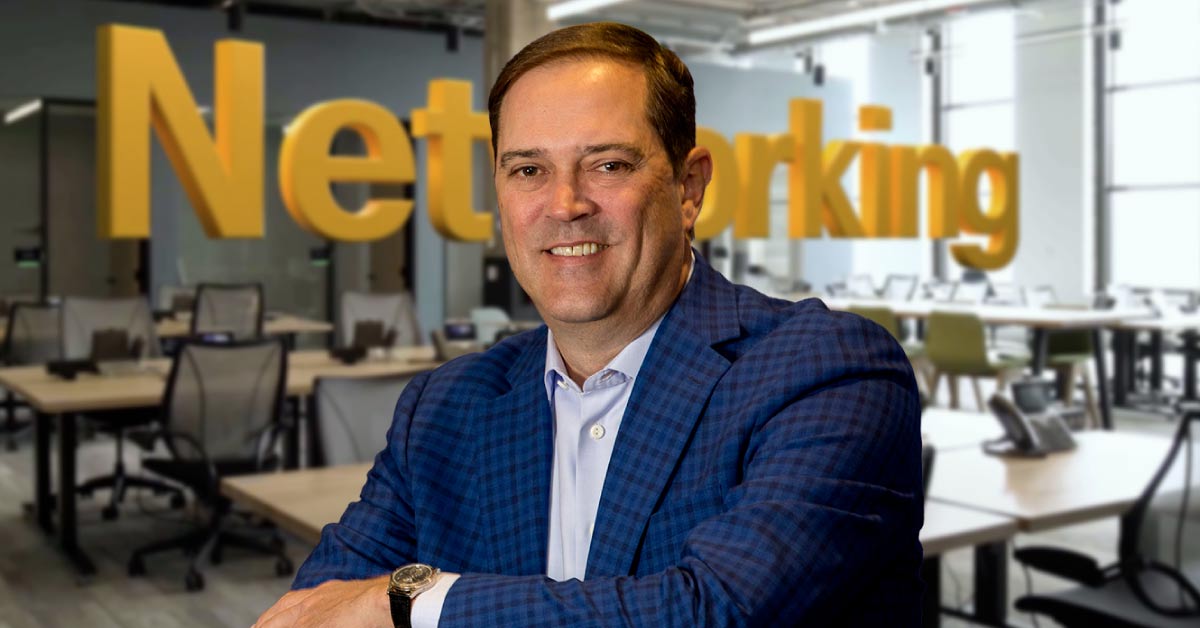
Chuck Robbins, Chair and Chief Executive Officer (@ChuckRobbins)
Liz Centoni, EVP, Chief Strategy Officer and GM, Applications (@lizcentoni)
Jonathan Davidson, EVP and GM, Cisco Networking (@jonathandavidsn)
Jeff Sharritts, EVP and Chief Customer & Partner Officer (@JeffSharritts)
Jeetu Patel, EVP and GM, Security & Collaboration (@jpatel41)
And more
To see the complete list of executive speakers, visit the Cisco Partner Summit website.
For those attending Partner Summit in-person, along with our line-up of amazing Keynotes and Business Impact Sessions, there are also other key things I wanted to highlight.
The Partner Hub is an immersive technology showcase made to enable conversations and networking, give attendees a chance to re-charge, or simply grab a cup of coffee. New this year to the Partner Hub: Bookable Meeting Spaces.
The Women in Channels Reception is open to all Partner Summit attendees, and is a celebration of diversity and inclusion across the partner landscape.
As you build out your schedule, sign up to participate in Beach Clean Up Days on the mornings of November 7 and 8. This is just one of the many ways Cisco has committed to making a positive impact at this year’s Partner Summit.
Partner Summit is also our opportunity to celebrate YOU—our amazing partners—and all the ways we’re truly Greater Together. During the event we’ll recognize our Regional and Global Award Winners—be sure to keep an eye out for those announcements, and share the goodness on social media.
For those attending the Cisco Partner Summit 2023 Live Digital Broadcast, you’ll also find that the team has worked to create a rich experience for virtual attendees—fully integrated with the Partner Launch Experience. Not only will you be able to livestream Global Keynotes from the Partner Launch Experience platform, virtual attendees will also be able to access all the amazing content you’ve come to expect from our Partner Launch Experience.
No matter how you choose to take part in Cisco Partner Summit 2023, let’s engage on social media and use #CiscoPS23!
I can’t wait to see you all in Miami Beach and be Greater Together!
We’d love to hear what you think. Ask a Question, Comment Below, and Stay Connected with #CiscoPartners on social!
Cisco Partners Facebook | @CiscoPartners Twitter | Cisco Partners LinkedIn
Soon, we'll be together for Cisco Partner Summit 2023, in-person in Miami Beach and digitally, November 7-8.
Here’s everything you need to know before the big event. Read More Cisco Blogs
Cisco Full-Stack Observability solves the modern downtime dichotomy where IT teams are running blind to the end user experience.
As teams bump up against the uncomfortable reality that their view of… Read more on Cisco Blogs
Cisco Full-Stack Observability solves the modern downtime dichotomy where IT teams are running blind to the end user experience.
As teams bump up against the uncomfortable reality that their view of application uptime does not fully reflect the end-user experience, they’re coming to the realization that observability across the entire IT estate is essential.
Customers and end users engage with modern organizations across an ever-expanding fabric of digital touchpoints – websites, ecommerce platforms, POS systems, mobile apps, smart devices, and collaboration channels. These interactions are facilitated across cloud, SaaS, and on-premises networks by complex layers of APIs, cloud services, network overlays, and containers.
Teams spanning DevOps, SecOps, ITOps, and site reliability engineers (SREs) are focused on managing application performance, which is often measured against a mix of service level agreements (SLAs), service level objectives (SLOs), and IT-centric key performance indicators (KPIs).
However, with the shift to digital business models, these measures are overly focused on metrics that have limited or no relationship to the actual digital experience of end users, and the business outcomes they create. Traditional uptime monitoring feeds these metrics, taking place on servers, clouds and websites, leaving a gap of “invisible downtime” for which IT teams are running blind.
Digital experience matters more than ever. End users expect an application to be available, and highly responsive, every time. While they may not know what is causing performance issues, they notice, for example, sluggish response times, and transaction errors.
It’s no longer enough to wait for a problem to occur before addressing the underlying issues behind uptime degradation or disruption. Discovering an issue because a help ticket has been issued is not an effective strategy.
The most recent Cisco AppDynamics App Attention Index tells us that 83% of people have encountered problems with applications and digital services. When that happens, most say they are likely to switch to an alternative, share their negative experiences, or delete the digital service permanently.
The experience of using an application can be impacted by many variables. Some sit within the application itself such as pages loading slowly, poor response times, or security failures. External factors outside the application include bad internet connectivity, 4G/5G mobile network issues, slow payment gateways, or technical issues with third-party plug-ins.
While each scenario is potentially subject to its own SLA, when the spinning wheel appears, the service itself is effectively unavailable even if systems under SLA may be operating within parameters. The mismatch means organizations that consistently meet or exceed their IT uptime objectives are no longer able to satisfy customers and end users.
In essence, the digital landscape has changed but teams have not changed the definition of downtime, along with application monitoring processes and frameworks, to align with the digital economy.
How should downtime then be assessed? How can they keep applications running at peak performance while also ensuring they continue to meet their SLAs? What strategies can be adopted?
Applications are now the front door of modern business. Neglecting this “front door” perspective potentially skews the view of how applications are performing in the eyes of users. It creates blind spots around end user experience downtime, an environment of “unknown unknowns,” that is decoupled from a range of possible, or even probable, negative business impacts.
Assessment of whether an application is “up” or “down” must include whether it’s experiencing invisible downtime, and the root cause of that downtime. This demands a broader scope of observability across every touchpoint – applications, end users, network, security, and the cloud.
Cisco Full-Stack Observability provides a real-time, end-to-end view of the application stack all the way to the end user. Deriving insight from observable telemetry captured across the entire service delivery chain and correlated to business outcomes makes it possible to understand application performance in a more holistic way. It also expands the metrics that can inform how SLAs, SLOs, and both business- and IT-focused KPIs are defined.
Past IT operating models are no longer adequate, yet vast volumes of telemetry data on the state and health of applications provide hidden, untapped signals to invisible downtime. Full-stack observability solutions from Cisco transform siloed telemetry data into actionable insights that provide shared context to IT teams so they can deliver exceptional digital experiences, optimize for cost and performance, and maximize digital business revenue.
Moreover, with the insights teams gain from Cisco Full-Stack Observability solutions, they can prioritize which downtime issues to tackle first based on what has the most business-impacting potential. In essence, DevOps, AppOps, NetOps, InfraOps, and SecOps teams can together see the ripple effect that performance issues have on the overall application experience, from the “front door” to back end, and connect it all to business metrics and outcomes.
For teams operating against SLAs, invisible downtime demands they broaden their view of the inputs and outputs of their observable systems. Inputs include application and infrastructure stacks, while outputs include business transactions, user experiences, infrastructure, and networks.
For organizations determined to drive their digital business forward, modern problems require modern solutions. Too many organizations have spent a lot of time and money trying to meet their uptime SLAs, but still have little or no visibility into the end user experience of their applications.
In the wake of ever-expanding digital touchpoints, that’s the equivalent of monitoring everything but seeing nothing because invisible downtime often represents the biggest potential impact on business.
Cisco Full-Stack Observability solutions help teams think and act differently. There will never be a single tool that solves every problem, but Cisco Observability Platform provides teams with access to solutions to address application observability, security, and optimization in their own context so they can see around corners – and finally put an end to invisible downtime once and for all.
With traditional monitoring solutions, IT teams are blind to "invisible downtime" that can negatively impact the end user application experience. Cisco Full-Stack Observability and the Cisco Observability Platform can give you visibility across the entire IT estate. Read More Cisco Blogs
Imagine a world where IT isn’t a labyrinth of complexity but instead a streamlined highway to innovation. That world isn’t a pipe dream—it’s a SASE-enabled reality.
As we navigate the complexities of … Read more on Cisco Blogs
Imagine a world where IT isn’t a labyrinth of complexity but instead a streamlined highway to innovation. That world isn’t a pipe dream—it’s a SASE-enabled reality.
As we navigate the complexities of a constantly evolving digital world, a telling remark from a customer onstage with me at Cisco Live in June lingers: “We don’t have time to manage management tools.” This sentiment is universal, cutting across sectors and organizations. An overwhelming 82% of U.S. businesses, according to a Deloitte survey, were prevented from pursuing digital transformation projects because of a lack of IT resources and skills.1 Without the right experts to get the job done, teams are often entangled in complex, disparate systems and tools that require specific skills to operate.
Today’s tech landscape presents a challenge that IT leaders can’t ignore: complex IT needs combined with a fiercely competitive talent market. Internally, teams are overwhelmed, often struggling to keep up with ever-evolving technical demands. In fact, many teams are strapped and rely on early-in-career staff to fill wide gaps left behind by more experienced predecessors. And the problem is only going to get worse.
For experienced IT workers, it’s an attractive time to entertain new opportunities. According to a global Deloitte study, 72% of U.S. tech employees are considering leaving their jobs for better roles.2 Interestingly, a mere 13% of employers said they were able to hire and retain the tech talent they most needed.2
Now more than ever, organizations must rethink their approach to talent management and technology adoption to stay ahead of the curve.
In an era where time is a premium and complexity is the norm, the need for convergence has never been more apparent. Technical skills, while essential, are not enough. The real game-changers are adaptability, cross-functional collaboration, and strategic foresight. And yet, these “soft skills” can’t be optimally used if teams are entangled in complex, disparate systems and tools that require specialized skills to manage and operate.
So how do organizations tackle this dilemma? How do they not just keep the lights on but also innovate, improve, and lead? In a word: convergence. Unifying siloed network and security teams as well as systems and tools with a simplified IT strategy is key to breaking through complexity.
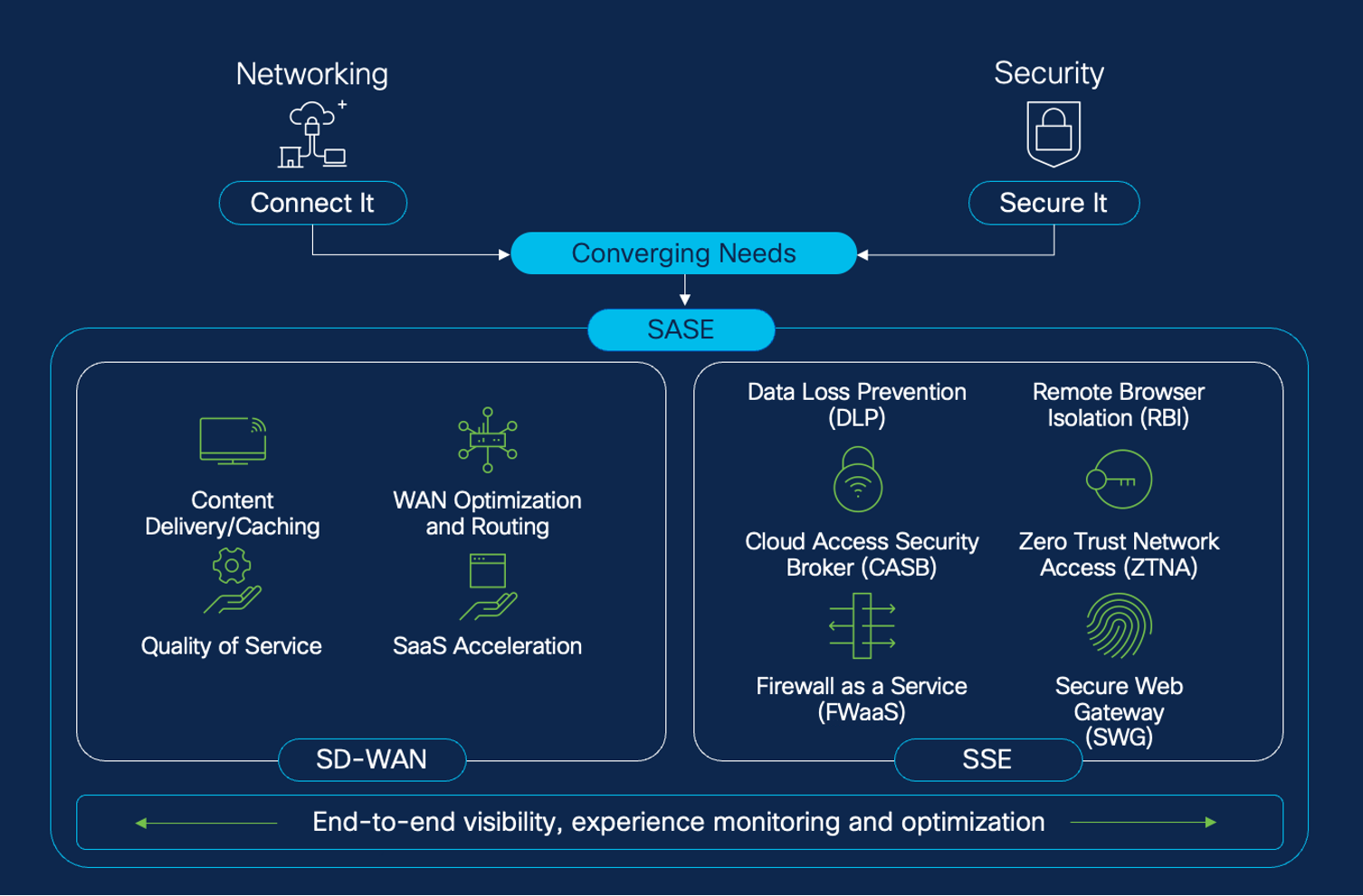
Secure access service edge (SASE) is more than just an architecture; it’s a vision for the future where the worlds of networking and security are not siloed and become one. Cisco takes a unified approach to SASE, where industry-leading SD-WAN meets industry-leading cloud security capabilities in one, robust platform to make managing networking and security easy.
Figure 1. SASE architecture converging networking and security domains (click to enlarge)
Unified SASE converges the two domains into one, streamlining operations across premises and cloud. Admins from both domains gain end-to-end visibility into every connection, making it easier to optimize the application experience for users, providing seamless access to critical resources wherever work happens. This converged approach to secure connectivity through SASE delivers real outcomes that matter to resource-strapped organizations.
Simplify IT operations and increase productivity
Administrators find it easier to manage networking and security when they are consolidated
73% reduction in application latency improves collaboration and enhances overall productivity3
40% faster performance on Microsoft 365 improves employee experience
Do more with less
60% lower TCO for zero-trust security enables budget reallocation to strategic initiatives3
65% reduction in connectivity costs helps ease the burden on IT budgets3
Enhance security without adding complexity
Simplify day-2 operations with centralized policy management, which makes it easier for IT teams to execute
Improve security posture through consistent enforcement—from endpoints and on-premises infrastructure to cloud—across your organization
Scale and adapt
Cloud-native architecture supports scaling and addresses the challenges of rapidly evolving IT landscapes
Prepares your organization for changes, reducing the need for constant upskilling or reskilling in IT teams
Organizations can use SASE architecture to advance their technological frameworks and strategically address the IT skills gap, leading to long-term business success.
SASE is not merely a technological evolution; it’s a paradigm shift in how we approach IT management. This lets IT admins focus less on tool management and more on driving business innovation, enriching user experiences, and evolving in tune with market demands.
Figure 2. Introducing unified SASE with Cisco+ Secure Connect, a better way to manage networking and security (click to play)
Cisco offers a unified, cloud-managed SASE solution, Cisco+ Secure Connect. From on-premises to cloud, this comprehensive SASE solution delivers simplicity and operational consistency, unlocking secure hybrid work for employees wherever they choose to work. The beauty of Cisco’s unified SASE solution lies in the principle of interconnecting everything with security everywhere–if it is connected, it is protected. It’s that easy.
Let’s drive the future together—simpler, more secure, and more agile. The time for SASE is now; the future is unified.
1. Tech Trends 2023, Deloitte Insights↩2. 2023 Global Technology Leadership Study, Deloitte↩3. Cisco research and customer results
Over half of organizations struggle to fill key IT roles. SASE helps scale a lean IT model to work smarter, more efficiently, and carve time to focus on new innovations. Read More Cisco Blogs
Cisco announces upcoming event with the financial community.More RSS Feeds: [...]