About (Edit profile)

This author has not yet filled in any details.
So far has created 1829 blog entries.

Cisco portfolio for transportation: What can we help you solve today? Scott Lantis on October 4, 2023 at 7:36 pm

At Cisco, we are building the bridge between our customer’s desired business outcomes and our technology that enables them. To help us do this effectively, we have developed an interactive, ind… Read more on Cisco Blogs

At Cisco, we are building the bridge between our customer’s desired business outcomes and our technology that enables them. To help us do this effectively, we have developed an interactive, industry-specific tool that illustrates how Cisco is making a difference in industries.

The annual update for the Cisco Portfolio Explorer for Transportation has just been released, and features five industry themes and sixteen associated use cases. Covering the transportation sub-verticals of roadways and intersections, rail, airports, and ports, the refreshed version of the tool provides an extensive look into how Cisco is driving a more connected and secure transportation environment. Read on for an overview of our highlighted transportation themes in the FY24 version of the Portfolio Explorer.

Secure Digital Infrastructure

The secure digital infrastructure theme defines the foundation of modern transportation connectivity. A multi-access wireless approach offers best-fit solutions for transportation organizations – from roadways and intersections, to rail and mass transit, to airports and ports. Implementing cybersecurity measures across the network ensures a secure, scalable critical transportation infrastructure.

Advanced Operations

Within the advanced operations theme, the foundational network is applied to forward-looking use cases to address emerging technologies, improve, and automate operations, and meet electrification and sustainability goals.

Visibility and Safety

Use cases in the visibility and safety theme are focused on achieving visibility into the physical environment – with sensors, cameras, and video analytics. Also, securing critical assets including heavy machinery and vehicles and gaining visibility throughout the supply chain.

Secure Connected Workforce

The fourth theme is secure connected workforce, and this set of use cases is focused on enabling those working in the field to access operational data and communicate with internal and external peers. A secure connected workforce also means enabling employees working from home or in a remote office – to collaborate across the organization.

Passenger Experience

The final theme is passenger experience. For many organizations – especially rail, mass transit, and airports – this is key and critical to their overall success. This set of use cases focuses on enabling seamless onboarding for mobile devices, providing innovative and revenue-generating digital services for passengers, and improving operations and customer experience with people flow analytics.

Check out the Cisco Portfolio Explorer for Transportation today!

Share

  The annual update for the Cisco Portfolio Explorer for Transportation has just been released, and features five industry themes and sixteen associated use cases. Covering the transportation sub-verticals of roadways and intersections, rail, airports, and ports, the refreshed version of the tool provides an extensive look into how Cisco is driving a more connected and secure transportation environment.  Read More Cisco Blogs 

By |2023-10-05T03:50:24+00:00October 5, 2023|Cisco: Learning|0 Comments

Building a transparent Notification Center to Enable Customer Control Maureen Robbs on October 4, 2023 at 5:52 pm

Personalization is critical to a guided customer experience. It helps build trust, foster relationships, and enables a deeper connection with customers.

At Cisco, we have been trying to help our… Read more on Cisco Blogs

Personalization is critical to a guided customer experience. It helps build trust, foster relationships, and enables a deeper connection with customers.

At Cisco, we have been trying to help our customers along each step of their post-sale experience for nearly a decade. And as a key part of that experience, we want our customers to have more control over what communications they receive – a more intentional step towards the right message, right person, right time goal that we are all striving to achieve.

Before we could begin, we took a thorough inventory of what exactly the post-sale experience for customers today looked like.

Evaluating a disconnected customer experience

One of the customer pages from the legacy experience

Over the years, we’ve built several programs where customers could sign up for various post-sale notifications to help guide them on their path to success – but they were fragmented and lacked transparency.

For instance, a customer could access a link via an email where they could enroll or unenroll from a specific Cisco product architecture. There was no way to access the link again if the customer changed their mind after unenrolling. It also was not totally clear to the customer exactly what they were unenrolling from.

Similarly, a customer could enroll in a digital journey from a form on the main website, Cisco.com, but they could not see what else they were subscribed to. There were 6+ programs of this nature that evolved over the years – each designed to help provide the customer more control over their experience, but lacking a critical ingredient – transparency.

Thus, began an initiative to build a Notification Center that was flexible, centralized, and personalized just for what a customer was eligible to receive. One tool for a customer to rule their post-sale experience.

Rooted in research

We built the Notification Center collaboratively with our customer research and design team, evaluating all the different existing programs we had, we defined MVP parameters that would enable us to evolve the data model to support a more cohesive experience. We experimented with design, naming conventions, login experiences and more. Each piece of feedback helped our design team iterate and ultimately finalize the MVP requirements so our Orchestration & Notification team could build out the digital experience.

The research as well as consultation with Forrester served as the foundation and guiding principles as we went through the development process. These principles included:

Build an experience that fosters trust and respects customer privacy and choices​
Collect only data we can act on​ – do not collect unnecessary data
Design scalability and flexibility, between MVP to future platform​s
Design consistency ​
Configurable UI that can be personalized based off of customer eligibility for products and services
Flexible data model that can handle changing products and services
Strict adherence to Cisco data security and privacy standards

The new interface replaces two of our previous data collection customer experiences that were linked in our emails. Now customers have full access to:

View all subscriptions associated with their email
Activate/Inactivate subscriptions for Renewals, Services, and Adopt Emails at the Use Case or Solution level
Continue to nominate contacts for respective subscriptions
Provide feedback on the experience directly to the experience design team

This new system supports all of our critical integrations with Snowflake, Salesforce Marketing Cloud (SFMC), Cisco Single Sign On, and it can be integrated across other channels as well.

Implementation Changes

The new experience design

This new approach to subscription management not only transformed the front-end customer experience, but it also changed the granularity of data we were collecting. To enable it, we designed an entirely new back-end process to support the front-end application. We also had to make some significant changes to the data model and our custom activities in SFMC.

The Notification Center UI, built on an SFMC Cloud Page, is supported by a Python-based Flask API, acting as an intermediary connecting the front-end with the backend database.
We made the strategic decision to use PostgreSQL as our backend database, hosted on Google Cloud Platform’s Cloud SQL instance, to replace SFMC’s native Data Extension for storing customer choices and Custom Activity log data. We chose this because of the advanced data capabilities, indexing options, ACID compliance for data integrity, trigger support, and scalability.
The database shift significantly reduced our reliance on SFMC as a database. This change decreased the overall number of SFMC API calls from 18 to 13 and increased the Custom Activity processing efficiency from 52 to 70 requests per second while concurrently reducing latency from 60 seconds to approximately 13 seconds.
Digital journeys executed through SFMC previously had Cisco product architecture level entry criteria, meaning customers qualified for journeys if they bought a particular product. With the introduction of Notification Center data, we are mapping at the use case level, so we can build our journey segments based on the particular reason a customer bought a product. This transition has increased the granularity of our data while enabling a more personalized customer experience.
Additionally, we enabled a daily sync between the Notification Center customer database and Enterprise Use Case Eligibility data to ensure Notification Center UI displays content in accordance with each customer’s eligibility criteria for a specific use case.

What’s Next

Post-MVP release, we plan to expand our offerings to replace the remaining disconnected programs. We also want to expand what we can support with Notification Center to include notifications sent by different teams, language selections, channel selections, notification frequency, and progressive profiling.

The granularity of data that this experience allows us to collect will also help improve our data threading for customers, empowering more effective data science. This is an exciting first step into a much more personalized experience for customers.

Share

  Personalization is critical to a guided customer experience. It helps build trust, foster relationships, and enables a deeper connection with customers. At Cisco, we have been trying to help our customers along each step of their post-sale experience for nearly a decade. And as a key part of that experience, we want our customers to  Read More Cisco Blogs 

By |2023-10-05T03:50:24+00:00October 5, 2023|Cisco: Learning|0 Comments

NSO Playground, A New Environment Available on Cisco Code Exchange Oleksii Borysenko on October 4, 2023 at 9:25 pm

The article is co-authored with Jesus Illescas, Cisco Software Engineer

The Cisco Code Exchange platform gathers shared code repositories related to Cisco and open-source technologies for security,… Read more on Cisco Blogs

The article is co-authored with Jesus Illescas, Cisco Software Engineer

The Cisco Code Exchange platform gathers shared code repositories related to Cisco and open-source technologies for security, networking, cloud, IoT, collaboration, mobility, and data center domains. Use cases on the exchange cover scenarios for automation, monitoring, telemetry, and network automation.

We constantly improve the Code Exchange platform, adding new features like security scanners. The new platform version supports Cloud IDE, a browser-based integrated development environment that users can use to quickly start with related code/script. The Code Exchange Cloud IDE supports running related workflow with DevNet Sandbox, and promptly tries to deploy and run the project without deploying the repo locally or in your server.

NSO Playground is a user-friendly IDE

When it comes to code development, setting up environments to test and share with others can be a hassle. But worry no more! We’re excited to announce NSO Playground for Cisco Network Services Orchestrator (NSO), a new environment available on Code Exchange that simplifies your network automation journey with NSO.

NSO Playground provides a user-friendly browser-based integrated development environment (IDE) where you can dive right in and explore the world of NSO. It’s the perfect place to experiment with NSO examples and interact with different components without the need for complex installations or setups.

Get hands-on without the hassle

But that’s not all! NSO Playground also allows you to contribute your own examples and share them with the community. Your peers can instantly play with your examples, giving them a hands-on experience without any installation hassles.

With NSO Playground, you have two options to choose from: System Install and Local Install. The System Install version is based on the official NSO container, providing a closer production environment for your experiments.

To help you get started, we’ve created two repositories on GitHub: one for System Install and another for Local Install. These repositories contain all the information you need to explore the playground, add your own examples, find help, and even access an example to play around with.

NSO Playground system install
NSO Playground local install 

Share

  When it comes to code development, setting up environments to test and share with others can be a hassle. Now, the new NSO Playground on Code Exchange simplifies your network automation journey with Cisco Network Services Orchestrator (NSO).  Read More Cisco Blogs 

By |2023-10-05T03:50:23+00:00October 5, 2023|Cisco: Learning|0 Comments

The complexity of the web of life Emma Reid on October 3, 2023 at 4:00 pm

Cecilia Nilsson

This post was written by Cecilia Nilsson, a biologist currently based and working as a researcher at the Department of Biology at Lund University. Her work focuses on using different… Read more on Cisco Blogs

​Cecilia Nilsson

This post was written by Cecilia Nilsson, a biologist currently based and working as a researcher at the Department of Biology at Lund University. Her work focuses on using different kinds of radars and data science to monitor animal movements at scale, with a focus on migration systems and bird population conservation. She also uses these research techniques to investigate conflicts that arise when humans encroach on aerial habitats, such as wind power installations and bird strikes at airports.

Join us on October 26, 2023 to hear Cecilia Nilsson present on Cisco Networking Academy’s Women Rock-IT program, and to learn how analyzing weather radar data and utilizing machine learning for biological purposes is saving the lives of birds.

The Women Rock-IT Program addresses the gender gap in STEM-related subjects. Established in 2014, the program has reached an audience of over 2 million people, featuring 156 female speakers, 91 live TV broadcasts and 78 blogs. As a result, more than 974,000 people have enrolled in technology courses.

The loss of biodiversity is one of the greatest threats facing humanity. By destroying habitats and threatening the survival of species, we are pulling out threads from the web of life that sustains us, and supplies us with food, oxygen, and clean water. By weakening it we are also reducing nature’s resilience to long-term changes and extreme events – with less genetic variation and fewer individual organisms, ecosystems become more vulnerable to threats such as droughts, flooding and disease.

A new approach to conservation

The complexity of the web of life around us, with all its variation, fascinated me from a young age and made the choice of studying biology an obvious one. However, while studying at university I soon realized that I was more drawn to technical methods and theoretical aspects in the field of biology, and I strayed far from practical conservation applications. As a PhD student in Lund, Sweden, I used tracking radar to study the details of bird flight. Using a discarded military tracking radar, we could track the movement of free-flying birds in the sky with very high precision, registering every wing beat. We used this data to test evolutionary predictions of bird movements and bird flight. I loved learning about radar technology and delving into the details of bird flight–but I was bothered by the feeling of documenting something we were slowly losing.

“I wanted to contribute, to learn more and to protect it.”

After finishing my PhD, I stayed in the academic world and started working as a post doc, and later a university researcher, focused on the use of weather radar networks for biological applications. The more I learned about weather radars, the more I could see their potential as a conservation tool. Weather radars constantly monitor the sky, registering everything, not only weather, but also birds and insects. This had been known for a long time, but the complexities of extracting from the huge datasets weather radars produce had limited its use in biology.

Advancements in technology unlocked opportunities

About 10 years ago, computer processing power and storage had advanced to the point that large-scale use of weather radar data for biology started to be possible. Since then, I have been working in the small–but rapidly expanding–academic field of analyzing weather radar data for biological purposes. Weather radars emit radio waves (usually in C or S-band) and then listen for the echo of objects in the sky reflecting the wave back to the radar antenna.

A tracking radar antenna, image courtesy of Johan Bjorkman

All objects in the sky return echoes, from tiny raindrops to large aircraft. Weather radars are mainly built for detecting rain droplets, which are used to map and track precipitation systems. But by focusing on specific characteristics of the returned echo, as well as information on the movement of the object creating the echo, we can separate out biological objects such as birds, insects, and bats from other data. Machine learning classification algorithms have allowed us to fine-tune this segmentation and analyze large datasets.

Weather radar data offers several advantages for biodiversity monitoring that are very difficult to obtain by other means. First of all, they monitor a habitat that we know little about and have few other ways of mapping: the aerial habitat. Many flying animals spend large parts of their life in the air, making it a crucial part of their habitat. Secondly, weather radar data provides something that is very rare in the field of conservation biology: long time series of more or less standardized data. By using long time series of archived data we can identify changes in the amount and movement patterns of flying animals, and by using networks of stations we can do this across large scales, identifying areas with decreasing populations.

Applying new techniques to protect wildlife and their habitats

Some of the practical applications we have developed are predictive models that can show when large numbers of birds are on the move during migration. This is currently being used to set up different automatic warning systems to limit dangers for migratory birds and humans alike. For example, turning off lights on high rise buildings to avoid bird crashes, and pausing wind turbines in migration corridors to avoid bird collisions with rotor blades. Another application alert in development warns poultry farmers when large numbers of wild birds are flying over their farms, allowing them to take action to protect their livestock against avian influenza and other pathogens the birds may carry. I have also been involved in using large-scale information from weather radars to map bird movements around airports, increasing knowledge of how bird migration patterns affect the risk of bird strikes between airplanes and birds.

Cecilia at work.

I feel very lucky to have been a part of establishing the use of weather radar data as a biodiversity monitoring tool over the last decade, and I believe this technique has tremendous potential for the future. I am happy that I now contribute to the monitoring of at least one small part of the diverse web of life, and I will continue exploring the ways we can use this tool to assess and address threats to biodiversity and the natural world around us.

Register to hear Cecilia and listen to other women who rock IT

Women Rock-IT

Share

  As part of the Women Rock-IT program, biologist Cecilia Nisson shares more about her career path in conservation.  Read More Cisco Blogs 

By |2023-10-04T15:49:54+00:00October 4, 2023|Cisco: Learning|0 Comments

Driving a Successful Sustainability Agenda – A Deep Dive into a Holistic Approach Dany Sammour on October 4, 2023 at 12:00 pm

Driving a sustainability strategy comes with incredible complexity and a spectrum of expectations. With the stakes being as high as it gets – the preservation of our planet – this is one we need to ge… Read more on Cisco Blogs

Driving a sustainability strategy comes with incredible complexity and a spectrum of expectations. With the stakes being as high as it gets – the preservation of our planet – this is one we need to get right. The question is: HOW?

In Cisco CX we have designed a coherent and holistic framework to help you synergize different aspects of sustainability into a unified strategy. This enables a strategic alignment between sustainability & business goals, and a comprehensive stakeholder engagement – integrating Environmental, Social, and Governance (ESG) metrics into business performance indicators and optimizing the allocation of resources.

Importantly, our framework recognizes the inherent diversity among stakeholders and their varying priorities and value drivers in the realm of sustainability. It can be a common scenario where initiatives aimed at sustainability are often confined within silos, resulting in different parts of the organization operating at different maturity levels.

By acknowledging this reality, our framework helps organizations align their capabilities and benchmark themselves against industry leaders. This entails a comprehensive approach that takes into account the distinct perspectives and objectives of different stakeholders. By integrating their efforts and fostering collaboration across departments, organizations can bridge the gaps in maturity levels and ensure a more cohesive and holistic approach toward sustainability.

Moreover, this integrated approach promotes a more unified organizational culture, where sustainability becomes an intrinsic part of the overall business strategy.

In part 1 of this 2-part blog series, I want to share with you our signature approach, developed by Cisco CX to drive a successful sustainability agenda.

Six Dimensions to driving a holistic approach to sustainability

We take a structured approach in assessing the technology maturity across six key dimensions: Strategy, Governance, Execution, IT for Sustainability, Sustainable IT, and ESG Data Management. By evaluating each dimension, we help our customers gain valuable insights into their current state, identify areas for improvement, and translate them – leveraging our expertise – into a roadmap.

Strategy: Focuses on evaluating your approach to sustainability within your overall business strategy. It assesses how effectively sustainability goals are aligned with your vision and mission. This also considers the level of integration of sustainability into strategic decision-making processes and the establishment of clear objectives and targets.
Governance: Examines your governance structure and processes regarding sustainability. It evaluates the presence of dedicated sustainability governance bodies, the level of senior leadership involvement, and the effectiveness of oversight mechanisms. This dimension also takes into account the organization’s commitment to transparency, accountability, and risk management related to sustainability initiatives.
Execution: Assesses your ability to translate your sustainability strategy into action. It evaluates the presence of well-defined implementation plans, the allocation and skills of resources, and the engagement of relevant stakeholders. This also examines your capability to drive change, implement more sustainable practices, and monitor progress effectively.
IT for sustainable business: Focuses on your utilization of technology to support sustainability initiatives. It assesses the integration of sustainability considerations into IT strategy and the use of technology solutions to optimize resource consumption, reduce environmental impact, and enhance operational efficiency. This also examines your capability to leverage emerging technologies for sustainable innovation.
Sustainable IT: Evaluates your internal IT infrastructure and operations with a sustainability lens. It assesses your efforts to minimize energy consumption, reduce e-waste, and adopt environmentally friendly practices in IT procurement and asset management. This also considers your commitment to sustainability-related IT standards and certifications.
ESG data management: Focuses on your ability to collect, analyze, and report ESG-related data. It assesses the quality, accuracy, and completeness of data collection processes, as well as your capability to derive meaningful insights from the data. This also evaluates your transparency and reliability in reporting ESG performance to stakeholders.

Focus on Measurable Outcomes: Turning Data into Action for Progress on Sustainability

In Cisco CX we love turning data into actionable insights.

It’s time for organizations to move beyond data collection and analysis and focus on translating those insights into tangible actions and committing to implementing practices designed with sustainability in mind. Energy management offers a great example; Access to data allows us to evaluate consumption, optimize usage, implement energy-efficient technologies, and explore renewable energy sources. Taking action can result in reducing emissions, reducing costs, and improving operational efficiency.

Let’s not forget, that measurable outcomes play a vital role in progressing the sustainability agenda; we all need to set quantifiable goals, track progress, monitor performance, identify gaps, and take corrective actions as needed. In other words, we need to be able to report on our progress and milestones transparently. Not only to be accountable and build trust but also to benchmark our performance against industry peers and further improve.

Be more sustainable with Cisco CX

Leveraging our years of experience, Cisco CX’s comprehensive approach to guide you through your sustainability transformation journey can help you achieve measurable outcomes.

Sustainability can be a competitive differentiator in today’s fast-changing business landscape. Contact us to understand where you stand, compare yourself with your industry peers, and develop an executable roadmap to advance your sustainability journey.

Together, let us create a better world through technology and sustainability!

In part two of my blog, I will look at the different personas and the value drivers for sustainability. Stay tuned!

Share

  As sustainability becomes a business imperative among business leaders, a Cisco executive identifies 6 key technology maturity dimensions and looks at how taking a holistic approach to sustainability can give you a competitive advantage to your business and help meet sustainability goals at the same time!  Read More Cisco Blogs 

By |2023-10-04T15:49:54+00:00October 4, 2023|Cisco: Learning|0 Comments

Cisco Refresh reinforces sustainability efforts Linda D’Amico on October 4, 2023 at 1:00 pm

In a panel discussion led by Cisco within the Energy and Transition stream of Climate Week NYC’s “The Hub Live”, experts explored the topics of “transforming grids globally, and the role of technol… Read more on Cisco Blogs

In a panel discussion led by Cisco within the Energy and Transition stream of Climate Week NYC’s “The Hub Live”, experts explored the topics of “transforming grids globally, and the role of technology, digitalization, and collaboration on the road to renewable expansion.” Cisco Refresh, one of Cisco’s earliest sustainability initiatives, is now in its third decade of existence and continues to make a positive impact on the planet.

Our long-standing programs focused on return and reuse, including our remanufactured products offered through Cisco Refresh, help contribute to our customers meeting their sustainability goals, while also helping us make progress towards our Platform for Accelerating the Circular Economy (PACE) Capital Equipment Pledge. These programs can create a second life for equipment, thereby saving resources required for new manufacturing and reducing waste.

Sustainability at different price points

At Cisco, one of the priorities of our environmental sustainability strategy is to evolve the business to circular. Cisco Refresh can support customers and partners in this transition.

Cisco certified remanufactured equipment meets the same quality standards that you would expect from equivalent new Cisco products, it is attractively priced, ships fast, and is backed by the same Cisco warranty and service options as the equivalent new product. It extends the life of existing equipment and can help different tiers of organizations leverage their IT to reach sustainability goals.

At the same time, remanufactured technologies can serve as a part of purchases. What we recommend is a blended approach to technology purchases—one which uses cutting edge technologies in the parts of your infrastructure where you are seeking performance and efficiency gains, and remanufactured equipment in places where legacy products are meeting your needs just fine. This has emerged as a critical part of Cisco customers’ business strategy.

Environmental footprint improvement

Immediately available, the Cisco Refresh options require just a small fraction of the energy, raw materials, and water it would take to build a new product from scratch. And the remanufactured product goes on to have a second life—or third, or more. It supports sustainability and customers experiencing rapid growth who need access to Cisco technology on short notice.

With this in mind, remanufactured product options are one to recognize when we talk about the future of technology and our planet at Climate Week or any other week for that matter. If you are interested in connecting with us to learn more based on your needs and how you can support circularity and reduce natural resource use by incorporating remanufactured equipment into your sustainability plan, please reach out.

Contact us about the Cisco Refresh program and

Cisco Certified Remanufactured Equipment

Share

  Cisco Refresh is an initiative that is designed to help our customers meet their sustainability goals.  Read More Cisco Blogs 
By |2023-10-04T15:49:53+00:00October 4, 2023|Cisco: Learning|0 Comments

Cisco Named An Official Technology Partner of the New England Patriots on October 4, 2023 at 12:00 pm

Cisco has been named An Official Technology Partner of the [...]

By |2023-10-04T15:49:40+00:00October 4, 2023|​Cisco Newsroom: Enterprise Networking|0 Comments

Forecasting Capacity in Cisco Catalyst SD-WAN Vivek Agarwal on October 3, 2023 at 2:59 pm

Organizations are increasingly adopting software-defined wide area networks (SD-WAN) to enhance network performance, reduce costs, and improve overall connectivity.

Using artificial intelligence (AI)… Read more on Cisco Blogs

Organizations are increasingly adopting software-defined wide area networks (SD-WAN) to enhance network performance, reduce costs, and improve overall connectivity.

Using artificial intelligence (AI) and machine learning (ML) for IT operations (AIOps), Cisco SD-WAN enhances and simplifies network management by using predictive analytics based on AI and ML techniques. The result is a proactive tool to address potential network issues before they degrade network and application performance.

Features desired by networks operators for such proactive actions include:

Predictive Path Recommendations (PPR), which suggests preferred paths for various application groups at each site within an overlay based on long-term modeling of path quality.
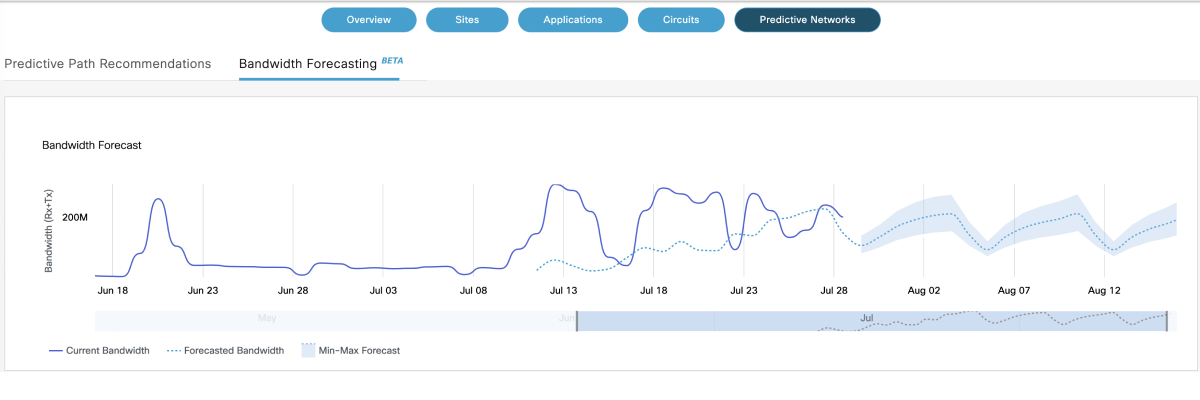
Bandwidth forecast for capacity planning, giving operators insights into possible future network usage based on extensive past usage patterns.
Anomaly detection for network KPIs (tunnel loss, latency, jitter), application usage patterns with individual sites, and user application usage profile.
Application modeling to help network operators better understand the impact of rolling out new applications in the overlay so they can implement the correct policies for best performance and minimal impact.

In my last blog, we discussed PPR and demonstrated how it gives operators the best performance for applications on their fabric. In today’s post we will delve into Bandwidth Forecast. To fully leverage the benefits of SD-WAN, effective capacity planning is crucial to help ensure optimal network performance, less downtime, improved cost control, more seamless operations, and a superior user experience.

The Bandwidth Forecast feature takes a comprehensive approach to provide accurate predictions of circuit usage, providing visibility into which circuits are likely to breach the capacity threshold based on the predicted usage. This helps network operators monitor usage trends on the circuits and provides capacity planning for the overlay.

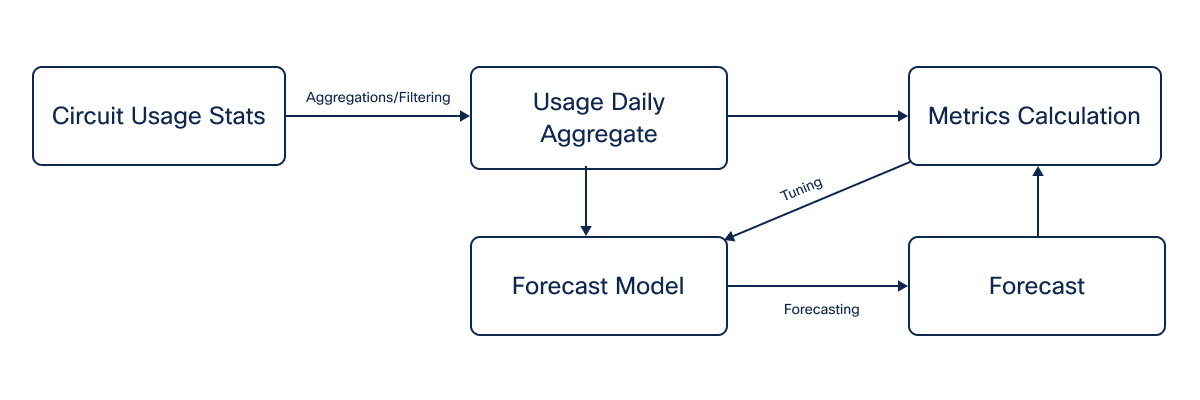
The forecasting is primarily based on the RX/TX bandwidth information of circuits in the WAN fabric. To ensure insights use underlying long-term trends, the circuit usage data is aggregated as daily data points while tracking daily Min/Max ranges. Aggregated data over extended periods is used to generate a forecast for up to three months in the future.

Various other features within this data set can be further leveraged to enhance forecast accuracy. These include:

Type of circuit (e.g., MPLS, private internet, LTE)
Type of applications using the circuit (i.e., top 10 applications and their respective volume)
Number of users at the site served by the circuit
Regional holiday list and bandwidth information features

To achieve the best forecast possible, a combination of common predictors and those based on deep learning techniques are used to generate more reliable and robust forecasts.

Pre-processing of interface statistics for training and inference pipeline (Click image to enlarge)

Forecast quality is continuously monitored for accuracy. If any data or model drift or deviation from expected results is observed, retraining of the model is triggered based on updated data sets to improve model accuracy. Furthermore, forecasts are assessed for long-term overestimation or underestimation, ensuring that it faithfully predicts the bandwidth to assist network operators in capacity planning and decision-making process.

The Bandwidth Forecast feature in Cisco SD-WAN Analytics helps give network operators a better understanding of the following:

Growth Trends: By analyzing historical data presented side by side with the forecast, organizations can identify patterns and anticipate future bandwidth demands. This empowers them to plan for anticipated growth without disruptions.
Seasonality: Long-term visibility into seasonality of usage over the historical period over which the training data set is derived from. The daily, weekly, and monthly seasonality is also factored in while making the forecast and the pattern continues into the forecasted data points.
Surge: Although visibility is provided into historical surge usage in the overlay so network operators can correlate it to global events (e.g., Black Friday) or internal events (e.g., company all-hands video stream), the model is effective in minimizing the impact of such data points while making long-term forecasts.
Min/Max Band: The daily data points for forecast has three components, Min, Mean, and Max. The forecast is presented with emphasis on the daily mean value while still showing a Min/Max Band so that the network operators can get insights into usage spikes within the day.
Model/Forecast Performance: Historical usage data is presented along with the past forecast data points for a quick visual comparison of how the forecast performed against actual recorded values in the past.

User interface

The Bandwidth Forecast feature can be activated for a specific overlay in the Catalyst SD-WAN Analytics Dashboard. This appears under the “Predictive Network” tab. Users can choose the circuits in the overlay for the forecast generation.

A table of circuits with all related metrics such as site or provider info, RX/TX bandwidth, and total usage is displayed, helping users select the circuits for which they want to visualize Bandwidth Forecast details. The minimum data set requirement for forecasts to be generated is 12 weeks of historical daily data points for each circuit.

The workflow is subject to the following:

The table shows only circuits configured on physical interfaces and this will exclude any circuits configured on logical interfaces (e.g., sub-interfaces, loopback, dialer-group).
Default sorting is based on descending order of RX/TX bandwidth, which helps bubble most heavily used circuits to the top of the table. The chart display is used to show the forecast for the Top Circuit.
Users can select any other circuit by clicking on the checkbox.
Users can search and sort as they wish to isolate specific circuits of interest.
Table of circuits and their metrics [Click image to enlarge]Bandwidth Forecast for selected circuit showing actual and predicted (dotted) values [Click image to enlarge]

Metrics

Accurate bandwidth forecasting is critical in capacity planning. One key metric is the accuracy of the forecasted bandwidth requirements. A successful forecast should closely align with the actual capacity goals for your business. The current solution computes mean absolute percentage error (MAPE) and mean absolute scaled error (MASE) scores in addition to tracking percentiles. Any of these can be used as the optimization target for the predictors used. The choice of target metrics for the predictors can be specified as per the needs for a specific overlay or use case.

By accurately predicting bandwidth requirements, organizations can optimize traffic routing, provision appropriate link capacities, manage QoS effectively, plan for scalability, and ensure adherence to SLAs. This proactive approach enables businesses to leverage the full potential of SD-WAN, delivering enhanced network performance, improved user experiences, and the ability to adapt to changing business needs. As organizations embrace the digital transformation journey, incorporating bandwidth forecast in SD-WAN capacity planning becomes a key strategy for success.

Learn more about Cisco SD-WAN, Analytics, and WAN Insights:

Cisco SD-WAN Analytics

Cisco SD-WAN vAnalytics Animated Explainer Video

Share

  Bandwidth Forecast predicts usage, aiding proactive capacity planning in SD-WAN. It leverages historical data, circuit details, applications, and extensive learning for reliable forecasts, optimizing network performance.  Read More Cisco Blogs 

By |2023-10-04T02:59:49+00:00October 4, 2023|Cisco: Learning|0 Comments
Go to Top