Connecting the BottleRock experience with Cisco Cisco Newsroom: Security
Cisco and LiveNation are elevating the festival experience by enhancing [...]


Cisco and LiveNation are elevating the festival experience by enhancing [...]
Whether in home offices or crisis zones, nonprofits are a [...]
Did you ever want to run Cisco Modeling Labs but did not have the hardware or software to do so? Or have you wanted to run a topology on your local deployment—but couldn’t because you did not have e… Read more on Cisco Blogs
Did you ever want to run Cisco Modeling Labs but did not have the hardware or software to do so? Or have you wanted to run a topology on your local deployment—but couldn’t because you did not have enough memory available locally? What about integrating CML into a CI/CD pipeline, which includes the creation and destruction of the entire pipeline, including CML?
You might think one answer to these problems would be to use CML in the cloud. And you’d be right. However, up until recently, the only supported platforms to run CML were either on bare metal servers or on VMware vSphere.
We have heard requests to have CML Software-as-a-Service (SaaS), and we’re working hard to make this a reality in the future. Our first step in this direction is to provide tooling and automation so you can deploy your CML instance into Amazon Web Services (AWS)! This tooling is available as of today on GitHub.
With this first step of automation and tooling comes a few limitations, including:
Tooling is currently only supported on AWS. We’re working on making this also available on Azure in a subsequent release.
It only supports an all-in-one deployment. Subsequent releases could include deployment of multiple instances to form a CML cluster.
This approach needs a bare-metal flavor to support all node types. Metal flavors are more expensive than virtualized instances; however, AWS does not support virtualization extensions on their non-bare-metal flavors. This is different from Azure.
You need to bring your own AWS instance AND your own CML license. No pay-as-you-go consumption model is available as of today.
CML software and reference platform files from the “refplat ISO” need to be made available in a bucket.
Automation must run locally on your computer, particularly a Linux machine with Terraform.
Due to the nature of CML’s function, the ability to run it in the cloud will never be cheap (as in free-tier). CML requires a lot of resources, memory, disk, and CPU, which comes at a cost, regardless of whether you run it locally on your laptop, in your data center, or in the cloud. The idea behind the cloud is to simplify operation and provide elasticity but not necessarily to save money.
The software requirements you’ll need to successfully use the tooling include:
a Linux machine (should also work on a Mac with the same packages installed via Homebrew)
a Bash shell (in case you use the upload tool, which is a Bash script)
a Terraform installation
the AWS CLI package (awscli with the aws command)
the CML software package (.pkg) and the CML reference platform ISO from CCO/cisco.com
An existing CML controller satisfies the first two requirements, and you can use that to install Terraform and the AWS CLI. It also has the reference platform files available to copy to an AWS S3 bucket. You also must download the CML distribution package from the Cisco support website and copy it to the AWS S3 bucket.
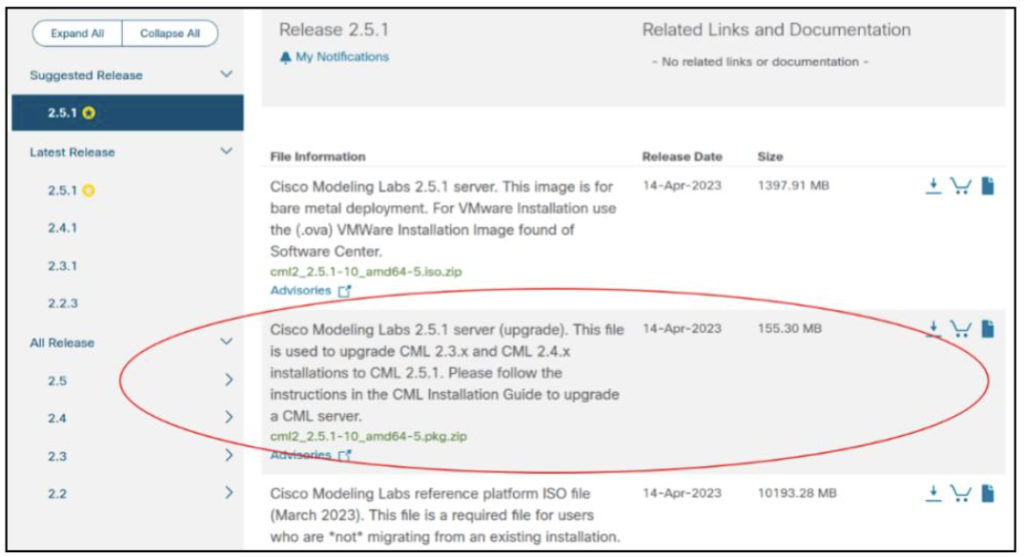
Select the distribution package circled in the following screenshot (the version might be different, but it ends in .pkg.zip), and you’ll need to unzip it for the upload tool to recognize it
For more detail, refer to the “Upload script” section of the README.md that is included in the cml-cloud repository.
Once you’ve installed the requirements and copied the files, you’ll find the actual procedure straight forward and meticulously documented in the README.md.
Here are the fundamental steps:
Configure the required S3 bucket, user, policies, secrets, and rules via AWS console (once).
Upload the binary files (images and software) into the created bucket (once or whenever new software is available).
Configure the tooling by editing the config.json file (once).
Run terraform plan followed by terraform apply to bring up an instance
Wait 5-10 minutes for the system to become ready; the address of the controller is provided as a result (“output” from Terraform)
Use CML in the cloud and profit!
Once you’re done, tear down the cloud infrastructure by executing terraform destroy.
Note: While no cost is incurred when you are not running CML instances, you’ll still need to pay for storing the files inside the created S3 bucket.
While CML AWS automation tooling is a first step toward CML SaaS, the tooling in its current form might not fit your needs exactly because of cost for bare-metal instances or the current dependency on AWS. Or you might want a pay-as-you-go service or something else. Let us know!
Just remember subsequent steps are ahead! Stay tuned, and tell us what you think in the meantime. We are extremely interested in how useful (or not) this first iteration of cloud tooling is to you and your organization and, going forward, what your specific requirements are. Please reach out to us on the GitHub issue tracker project.
Learn more about CML on cisco.com
GitHub Website
Cisco Support Website
GitHub Issue Tracker Website
Join the Cisco Learning Network today for free.
Now get enterprise-grade cloud management, networking and security out of [...]
VMware Cloud on AWS: What’s New at VMware Explore Las [...]
Co-authored by Carlos Rojas and David Gutshall.
Manufacturing was front and center at Cisco Live US 2023, with several of the world’s leading manufacturers coming together to share experiences and discuss technology trends, challenges, and innovations. For example, Dr. Henning Löser, Head of the Audi Production Lab at Audi AG, joined the Cisco team for an Innovation Talk and Cube interview about the convergence of information technology (IT) and operational technology (OT). Dr. Löser shared details about the company’s innovative plans to virtualize key production assets with the goal to increase flexibility, lower costs, reduce maintenance, and improve security. A journey toward what Audi calls the Edge Cloud for Production (EC4P) platform.
We also hosted a Manufacturing Leadership Summit that brought together industry leaders from auto, renewable energy, pharmaceuticals, food and beverage, heavy industry, etc. for a more intimate discussion of experiences, challenges, and innovations. I sensed an undercurrent of positive energy and mutual respect as these leaders shared their stories around increasing levels of digitization, improving security, and deploying wired and wireless networks in new and existing plants and production lines. Many discussions focused on how to best drive IT/OT convergence, especially driven by tools like Cisco Catalyst Center (formerly known as Cisco DNA Center). Attendees also discussed efforts to boost visibility and cybersecurity. And we heard about the push to upgrade networking in existing plants and invest in wireless networks for automated guided vehicles (AGVs) and other mobile assets.
Having mulled over what I heard at Cisco Live US, I’ve landed on these five takeaways.
As manufacturers increase digitization on factory floors, they can no longer look to individual pieces of hardware for certain features or functions. Instead, they need to invest in software that can provide the needed capabilities.
This paradigm shift was a key message emerging from the iTalk about Audi’s collaboration with Cisco. As Dr. Löser has noted, “To increase security, decrease support requirements, and improve flexibility, Audi is developing its Edge Cloud for Production (EC4P) platform. EC4P virtualizes production assets and relies on software-defined networking by Cisco IoT and Enterprise solutions that provide a scalable, resilient, secure and deterministic network.”
By making this shift from hardware to software, manufacturers can avoid significant maintenance headaches and reduce capital outlays. They can improve security and flexibility – all by streamlining hardware and virtualizing core computing assets like programmable logic controllers (PLCs), Human-Machine Interfaces (HMIs), and industrial personal computers (IPCs). The IoT Manufacturing Industry Summit provided evidence that this shift is already possible, with Roland Wagner – who leads Product Marketing at Codesys – demonstrating the readiness of the virtual PLC live.
In a pre-event survey, manufacturing leaders expressed concerns about cybersecurity, with visibility and risk assessment topping their priorities. Another common barrier: lack of accuracy in knowing their own asset inventory, traffic flows, and what each asset is connected to. And yet, as manufacturers work to enable further digitization initiatives, they need to do more than achieve that kind of baseline visibility. They also need to establish access policies to segment their network so they can more precisely control network activity and prevent malware spread.
We often think about cybersecurity in terms of prevention and defense. Interestingly, one manufacturer shared how its cybersecurity investments produced a tangible return. This company used Cisco networking and security technology to address insurance-company inquiries into cybersecurity within its production environment. Having sound, defensible answers paid off in the form of significantly lower insurance premiums – which helped fund additional investments.
I was impressed with the level of demand for wireless technologies. When it comes to 5G and private 5G, though, there seems to be a lot of appetite but few, if any, real-world deployments. It seems that by combining other wireless solutions – namely WiFi and Cisco Ultra-Reliable Wireless Backhaul – companies can support many of their business needs and use cases, especially around mobile assets, such as Automated Guide Vehicles and AMRs that require reliable wireless connectivity.
Cisco IoT has long advocated for stronger IT-OT partnerships. During the summit, it was fascinating to hear that nearly every customer reiterated the importance of IT-OT collaboration in powering the success of manufacturing digitization initiatives. Most of the attending companies and speakers had OT involvement showing the trend towards deeper collaboration.
Informally, I heard some manufacturing leaders voicing being impressed by Dr. Löser openness about Audi’s EC4P vision and journey. From my perspective, it’s a willingness to acknowledge that all automotive manufacturers are facing some common problems – and a recognition that it will take an ecosystem (that includes competitors) response to solve them. By the way, I don’t think automotive is the only manufacturing segment where this kind of collaboration will be vital!
The summit affirmed that the manufacturing industry has made significant progress in digitization. Companies now want to take the next steps toward cloud, virtualization, and advanced security – the capabilities that Cisco can enable with our scalable, resilient, and secure industrial networking. I observed significant interest in several of our solutions, including Secure Equipment Access and the recently announced SKUs within the Cisco Catalyst IE9300 Rugged Series switches. Both meet the need for simplicity, scalability, and ease of use.
Whether you joined us in Las Vegas or are catching up remotely, here are some ways you can engage with Cisco and learn about our solutions:
Tune in to the iTalk featuring Audi’s EC4P vision and journey.
Watch a brief interview with Dr. Löser.
Learn more about Cisco Industrial Wireless solutions.
Schedule a free non-obligation 1-on-1 consultation with our manufacturing experts via our manufacturing contact form.
Co-authored by Carlos Rojas and David Gutshall.
Manufacturing was front and center at Cisco Live US 2023, with several of the world’s leading manufacturers coming together to share experiences and discuss technology trends, challenges, and innovations. For example, Dr. Henning Löser, Head of the Audi Production Lab at Audi AG, joined the Cisco team for an Innovation Talk and Cube interview about the convergence of information technology (IT) and operational technology (OT). Dr. Löser shared details about the company’s innovative plans to virtualize key production assets with the goal to increase flexibility, lower costs, reduce maintenance, and improve security. A journey toward what Audi calls the Edge Cloud for Production (EC4P) platform.
We also hosted a Manufacturing Leadership Summit that brought together industry leaders from auto, renewable energy, pharmaceuticals, food and beverage, heavy industry, etc. for a more intimate discussion of experiences, challenges, and innovations. I sensed an undercurrent of positive energy and mutual respect as these leaders shared their stories around increasing levels of digitization, improving security, and deploying wired and wireless networks in new and existing plants and production lines. Many discussions focused on how to best drive IT/OT convergence, especially driven by tools like Cisco Catalyst Center (formerly known as Cisco DNA Center). Attendees also discussed efforts to boost visibility and cybersecurity. And we heard about the push to upgrade networking in existing plants and invest in wireless networks for automated guided vehicles (AGVs) and other mobile assets.
Having mulled over what I heard at Cisco Live US, I’ve landed on these five takeaways.
As manufacturers increase digitization on factory floors, they can no longer look to individual pieces of hardware for certain features or functions. Instead, they need to invest in software that can provide the needed capabilities.
This paradigm shift was a key message emerging from the iTalk about Audi’s collaboration with Cisco. As Dr. Löser has noted, “To increase security, decrease support requirements, and improve flexibility, Audi is developing its Edge Cloud for Production (EC4P) platform. EC4P virtualizes production assets and relies on software-defined networking by Cisco IoT and Enterprise solutions that provide a scalable, resilient, secure and deterministic network.”
By making this shift from hardware to software, manufacturers can avoid significant maintenance headaches and reduce capital outlays. They can improve security and flexibility – all by streamlining hardware and virtualizing core computing assets like programmable logic controllers (PLCs), Human-Machine Interfaces (HMIs), and industrial personal computers (IPCs). The IoT Manufacturing Industry Summit provided evidence that this shift is already possible, with Roland Wagner – who leads Product Marketing at Codesys – demonstrating the readiness of the virtual PLC live.
In a pre-event survey, manufacturing leaders expressed concerns about cybersecurity, with visibility and risk assessment topping their priorities. Another common barrier: lack of accuracy in knowing their own asset inventory, traffic flows, and what each asset is connected to. And yet, as manufacturers work to enable further digitization initiatives, they need to do more than achieve that kind of baseline visibility. They also need to establish access policies to segment their network so they can more precisely control network activity and prevent malware spread.
We often think about cybersecurity in terms of prevention and defense. Interestingly, one manufacturer shared how its cybersecurity investments produced a tangible return. This company used Cisco networking and security technology to address insurance-company inquiries into cybersecurity within its production environment. Having sound, defensible answers paid off in the form of significantly lower insurance premiums – which helped fund additional investments.
I was impressed with the level of demand for wireless technologies. When it comes to 5G and private 5G, though, there seems to be a lot of appetite but few, if any, real-world deployments. It seems that by combining other wireless solutions – namely WiFi and Cisco Ultra-Reliable Wireless Backhaul – companies can support many of their business needs and use cases, especially around mobile assets, such as Automated Guide Vehicles and AMRs that require reliable wireless connectivity.
Cisco IoT has long advocated for stronger IT-OT partnerships. During the summit, it was fascinating to hear that nearly every customer reiterated the importance of IT-OT collaboration in powering the success of manufacturing digitization initiatives. Most of the attending companies and speakers had OT involvement showing the trend towards deeper collaboration.
Informally, I heard some manufacturing leaders voicing being impressed by Dr. Löser openness about Audi’s EC4P vision and journey. From my perspective, it’s a willingness to acknowledge that all automotive manufacturers are facing some common problems – and a recognition that it will take an ecosystem (that includes competitors) response to solve them. By the way, I don’t think automotive is the only manufacturing segment where this kind of collaboration will be vital!
The summit affirmed that the manufacturing industry has made significant progress in digitization. Companies now want to take the next steps toward cloud, virtualization, and advanced security – the capabilities that Cisco can enable with our scalable, resilient, and secure industrial networking. I observed significant interest in several of our solutions, including Secure Equipment Access and the recently announced SKUs within the Cisco Catalyst IE9300 Rugged Series switches. Both meet the need for simplicity, scalability, and ease of use.
Whether you joined us in Las Vegas or are catching up remotely, here are some ways you can engage with Cisco and learn about our solutions:
Tune in to the iTalk featuring Audi’s EC4P vision and journey.
Watch a brief interview with Dr. Löser.
Learn more about Cisco Industrial Wireless solutions.
Schedule a free non-obligation 1-on-1 consultation with our manufacturing experts via our manufacturing contact form.
Industry leaders discussed the technology paradigm shift in manufacturing, and challenges and innovations around security, wireless technologies, and IT/OT collaboration. Read More Cisco Blogs
When you think of organizations investing to deliver the best application experience, you usually think of private sector businesses. But Brad Welsh from the State of Indiana Office of Technology (IOT) has made it his mission to deliver the best application experience to 6.8 million constituents statewide.
Brad, along with his team at the IOT, has helped 90 state agencies streamline operations, quickly fix their IT issues. and work better together – which means they all deliver a better experience to their constituents. And it’s all backed by Cisco Full-Stack Observability (FSO) solutions.
Brad says, “As a technology provider for the state, we have certain goals we need to achieve. We are shifting from a mindset of providing uptime on servers to a mindset of around-the-clock uptime across our infrastructure and business critical applications. It’s not just 8-to-5 anymore. Applications must be available all the time and we must have visibility into our network to make that happen.”
IOT supports a range of state partner agencies, from the Department of Motor Vehicles to the Commissioner of Higher Education. So, when service disruptions occur at any constituent-facing agency, Brad and his team need to address the issue quickly.
Brad Welsh teaching FSO to colleagues
“Before we implemented Cisco Full-Stack Observability,” Brad says, “we didn’t have the insight or visibility into the applications and across the network, that we needed. When an issue would arise, it would become a fire drill that would include many people across network, database, and many other IOT teams.”
And that meant if co-workers were called in to work on ruling out if an issue was caused by a network, by a third party vendor – a security issue – or something else – it was an interruption to their daily workflow and productivity But now with Cisco FSO, troubleshooting that used to take days now can take minutes.
There are no more fire drill meetings where everyone has to rapidly troubleshoot the root cause of issues in their respective area. In fact, Brad has empowered other IT teams he works with to take advantage of Cisco FSO technologies, and even held an event to educate other state agencies on how to modernize their applications and achieve full-stack observability.
The State of Indiana has a lot of transaction-based services. They have a lot of “Black Fridays” as Brad calls them – or days where their application infrastructure is tested by an onslaught of usage. For instance, a large citizen agency has end-of-month renewals that all need to be processed at the same time. In the past, it would be a disaster if this site went down at the wrong time – but recently Brad was able to determine if an issue was with the application infrastructure or the ISP – in minutes.
In addition to anticipating peak periods, Cisco FSO solutions have helped Brad deal with the unexpected.
During the pandemic, Brad was able to help the Workforce Development Department process a higher-than-average amount of unemployment claims. Ongoing application issues that had been a mystery to solve – like a certification printout for teachers’ licenses—became easier to troubleshoot and got fixed. And Brad’s office has helped the professional licensing agency he supports work better – so they can better serve their constituents at crunch time. And with Cisco Secure Application, security issues that used to bring down the whole application no longer do so because Brad can just temporarily shut down the part that needs to be fixed.
When you think of organizations investing to deliver the best application experience, you usually think of private sector businesses. But Brad Welsh from the State of Indiana Office of Technology (IOT) has made it his mission to deliver the best application experience to 6.8 million constituents statewide.
Brad, along with his team at the IOT, has helped 90 state agencies streamline operations, quickly fix their IT issues. and work better together – which means they all deliver a better experience to their constituents. And it’s all backed by Cisco Full-Stack Observability (FSO) solutions.
Brad says, “As a technology provider for the state, we have certain goals we need to achieve. We are shifting from a mindset of providing uptime on servers to a mindset of around-the-clock uptime across our infrastructure and business critical applications. It’s not just 8-to-5 anymore. Applications must be available all the time and we must have visibility into our network to make that happen.”
IOT supports a range of state partner agencies, from the Department of Motor Vehicles to the Commissioner of Higher Education. So, when service disruptions occur at any constituent-facing agency, Brad and his team need to address the issue quickly.
Brad Welsh teaching FSO to colleagues
“Before we implemented Cisco Full-Stack Observability,” Brad says, “we didn’t have the insight or visibility into the applications and across the network, that we needed. When an issue would arise, it would become a fire drill that would include many people across network, database, and many other IOT teams.”
And that meant if co-workers were called in to work on ruling out if an issue was caused by a network, by a third party vendor – a security issue – or something else – it was an interruption to their daily workflow and productivity But now with Cisco FSO, troubleshooting that used to take days now can take minutes.
There are no more fire drill meetings where everyone has to rapidly troubleshoot the root cause of issues in their respective area. In fact, Brad has empowered other IT teams he works with to take advantage of Cisco FSO technologies, and even held an event to educate other state agencies on how to modernize their applications and achieve full-stack observability.
The State of Indiana has a lot of transaction-based services. They have a lot of “Black Fridays” as Brad calls them – or days where their application infrastructure is tested by an onslaught of usage. For instance, a large citizen agency has end-of-month renewals that all need to be processed at the same time. In the past, it would be a disaster if this site went down at the wrong time – but recently Brad was able to determine if an issue was with the application infrastructure or the ISP – in minutes.
In addition to anticipating peak periods, Cisco FSO solutions have helped Brad deal with the unexpected.
During the pandemic, Brad was able to help the Workforce Development Department process a higher-than-average amount of unemployment claims. Ongoing application issues that had been a mystery to solve – like a certification printout for teachers’ licenses—became easier to troubleshoot and got fixed. And Brad’s office has helped the professional licensing agency he supports work better – so they can better serve their constituents at crunch time. And with Cisco Secure Application, security issues that used to bring down the whole application no longer do so because Brad can just temporarily shut down the part that needs to be fixed.
Delivering the best application experience for over 90 agencies and 6.8 million constituents can be a hard job. Cisco Full-Stack Observability solutions help the State of Indiana's Office of Technology resolve issues faster and plan for the unexpected. Read More Cisco Blogs

Across Europe, people are rethinking what they rely on the internet for: balancing classic demands for speed and reliability, with the growing needs of rising eco-consciousness, secure cloud infrastructure, and the increase of the Internet of Things (IoT) connecting our devices, from smart cars to home appliances. This trend perfectly aligns with the European Commission’s Digital Decade 2030, where secure and sustainable digital infrastructure is one of the top 4 priorities.
The 2023 Cisco Broadband Survey finds that as over 68% of consumers in Europe expect to connect cars, appliances, energy and water to the internet, broadband networks must scale to support new connectivity needs. Broadband is also seen by 77% of survey participants in Europe as critical national infrastructure, escalating the need for to accelerate the move towards a more sustainable and secure internet for all.
As the number of connected devices grows from billions to trillions, so does the demand for bandwidth and processing power to analyse all the data produced. According to the Cisco Broadband Survey, there’s no sign of this slowing down. Consumers are embracing the shift toward an ever more digital life. A majority of Europeans surveyed already have, or expect to have, their cars (64%), home appliances (68%), energy (74%) and water (61%) connected.
This is yet another signal for policymakers to ensure the need for more bandwidth is met by allocating more spectrum to mobile and wireless networks and removing existing barriers to the uptake of digital technologies.
Whilst half of consumers surveyed indicated feeling positive about new ways to connect their homes and lives to the internet, a majority (67%) saying that the cost-of-living crisis has changed the way they spend money on digital services: 18% have reported moving to a lower cost broadband package and 15% have cancelled streaming services.
Whilst speed remains the main reason for those planning to upgrade their broadband, the carbon-cost of connectivity is a concern for 64% European surveyed, with young people aged 18-24 the most worried. In addition, 72% said they would be willing to pay more for sustainable broadband, with around a fifth prepared to pay a price premium of more than 20%.
This supports a wider market trend, shown in a 2019 survey by Nielsen and a 2022 survey by Globescan, revealing widespread consumer awareness around the environmental impact of the products they use and a demand for companies to step up and mitigate negative impacts on the planet.
The carbon footprint of the information and communications technology sector is estimated to account for around 2.1 – 3.9% of global greenhouse gas emissions, and more than half of that comes from networks and data centers. Transition to next-generation networks and improved network efficiency with further adoption of ICT tools, while accelerating the move to renewable energy sources, are all essential responses for greening telecoms networks.[1]
The latest Wi-Fi technologies excel in low-power, cognitive radio techniques including spectrum sensing, spectrum sharing, and adaptive transmission and explain why national regulators have recommended consumers to switch to using Wi-Fi when at home during periods of peak energy consumption.[2]
Cisco is on a mission to transform the Internet for the Future, focusing on designing products with energy efficiency and security in mind, including circular economy principles in product development and business operations, and taking a smart and sustainable approach to lifecycle management.
Whilst speed, cost and reliability remain critical, building sustainable secure networks that can fuel global connectivity and automation has become a top priority. The European Union has been working on the development of new policies to support industry investment and as we approach World Radiocommunication Conference 2023 (WRC-23), we trust governments will seize the opportunity to secure more bandwidth for sustainable reliable connectivity.
About the Cisco Broadband Survey
The Cisco Broadband Survey is based on a survey of workers across 12 countries in EMEA. The extracted European data in this blog steams from 16,625 workers in the UK, Germany, Italy, France, Switzerland, Poland, Spain, Sweden, and the Netherlands. It was completed during January and February 2023. The sample includes respondents based in every region of each country, who either work full-time remotely; full-time in an office; hybrid, between home and the office; or on the frontline. The poll was conducted by independent research consultancy Censuswide, who abide by and employ members of the Market Research Society – which is based on the ESOMAR principles.
[1] ETNO, “The State of Digital Communications 2023” 2023
[2] Wi-Fi Alliance, “Wi-Fi: sustainable connectivity” 2023
Across Europe, people are rethinking what they rely on the internet for: balancing classic demands for speed and reliability, with the growing needs of rising eco-consciousness, secure cloud infrastructure, and the increase of the Internet of Things (IoT) connecting our devices, from smart cars to home appliances. This trend perfectly aligns with the European Commission’s Digital Decade 2030, where secure and sustainable digital infrastructure is one of the top 4 priorities.
The 2023 Cisco Broadband Survey finds that as over 68% of consumers in Europe expect to connect cars, appliances, energy and water to the internet, broadband networks must scale to support new connectivity needs. Broadband is also seen by 77% of survey participants in Europe as critical national infrastructure, escalating the need for to accelerate the move towards a more sustainable and secure internet for all.
As the number of connected devices grows from billions to trillions, so does the demand for bandwidth and processing power to analyse all the data produced. According to the Cisco Broadband Survey, there’s no sign of this slowing down. Consumers are embracing the shift toward an ever more digital life. A majority of Europeans surveyed already have, or expect to have, their cars (64%), home appliances (68%), energy (74%) and water (61%) connected.
This is yet another signal for policymakers to ensure the need for more bandwidth is met by allocating more spectrum to mobile and wireless networks and removing existing barriers to the uptake of digital technologies.
Whilst half of consumers surveyed indicated feeling positive about new ways to connect their homes and lives to the internet, a majority (67%) saying that the cost-of-living crisis has changed the way they spend money on digital services: 18% have reported moving to a lower cost broadband package and 15% have cancelled streaming services.
Whilst speed remains the main reason for those planning to upgrade their broadband, the carbon-cost of connectivity is a concern for 64% European surveyed, with young people aged 18-24 the most worried. In addition, 72% said they would be willing to pay more for sustainable broadband, with around a fifth prepared to pay a price premium of more than 20%.
This supports a wider market trend, shown in a 2019 survey by Nielsen and a 2022 survey by Globescan, revealing widespread consumer awareness around the environmental impact of the products they use and a demand for companies to step up and mitigate negative impacts on the planet.
The carbon footprint of the information and communications technology sector is estimated to account for around 2.1 – 3.9% of global greenhouse gas emissions, and more than half of that comes from networks and data centers. Transition to next-generation networks and improved network efficiency with further adoption of ICT tools, while accelerating the move to renewable energy sources, are all essential responses for greening telecoms networks.[1]
The latest Wi-Fi technologies excel in low-power, cognitive radio techniques including spectrum sensing, spectrum sharing, and adaptive transmission and explain why national regulators have recommended consumers to switch to using Wi-Fi when at home during periods of peak energy consumption.[2]
Cisco is on a mission to transform the Internet for the Future, focusing on designing products with energy efficiency and security in mind, including circular economy principles in product development and business operations, and taking a smart and sustainable approach to lifecycle management.
Whilst speed, cost and reliability remain critical, building sustainable secure networks that can fuel global connectivity and automation has become a top priority. The European Union has been working on the development of new policies to support industry investment and as we approach World Radiocommunication Conference 2023 (WRC-23), we trust governments will seize the opportunity to secure more bandwidth for sustainable reliable connectivity.
About the Cisco Broadband Survey
The Cisco Broadband Survey is based on a survey of workers across 12 countries in EMEA. The extracted European data in this blog steams from 16,625 workers in the UK, Germany, Italy, France, Switzerland, Poland, Spain, Sweden, and the Netherlands. It was completed during January and February 2023. The sample includes respondents based in every region of each country, who either work full-time remotely; full-time in an office; hybrid, between home and the office; or on the frontline. The poll was conducted by independent research consultancy Censuswide, who abide by and employ members of the Market Research Society – which is based on the ESOMAR principles.
[1] ETNO, “The State of Digital Communications 2023” 2023
[2] Wi-Fi Alliance, “Wi-Fi: sustainable connectivity” 2023
As the number of connected devices continues to grow, so does the demand for bandwidth, driving the increasing need to allocate more spectrum to mobile and wireless networks. Read More Cisco Blogs
This blog was written by Annika Mammen, former User Experience Engineer at Cisco
There are so many areas to consider when dealing with protecting and detecting threats, unfortunately cognitive overload is one problem that is often overlooked. Remember when search engines had a million news articles, reading suggestions, and market analysis on the home page. Users had to sift through the mountain of information and decide what was the best source for them. This is a prime example of cognitive overload, and this is something most SOC analysts know too well. Too many options and complex steps make users feel frustrated and confused. Their brain is being given too much information to process and gets overwhelmed. When Google came on the scene with a single search bar, users flocked to it because it changed the game. It helped organize data and surfaced up the most relevant pieces of information. The single search bar on the page made it very easy for users to understand what they had to do. A clean results page made it abundantly clear which links were most important. Finally, very few prominent buttons on the page made it easy to know what the next step was.
The same concepts and problems appear in the security space, frustrating SOC analysts and making their jobs much harder. They deal with having too much information, too many choices and no real way to organize the data to help users make better data-driven decisions. To have the best user experience possible, designers leverage a technique called progressive disclosure. It is a pattern used to break down the information into bite sized pieces and feed it to the user as and when needed. A good example of this in everyday life is the average ATM. The first screen just shows a few options like withdraw, deposit, and check account balances. Within seconds, you understand what action you must take to deposit your money. Once you choose an option, it takes you to the next bite sized step. Easy!
Similarly, the security world is filled with alerts, metrics, targets, etc. It is easy to fall into the cognitive overload trap. Cisco XDR uses progressive disclosure to help reduce that cognitive load, support novice and expert users, and help users to focus on high priority incidents and remediate quickly. Now, let us look at how we achieve that.
Incidents are ranked based on a color-coded risk score. Immediately the user’s focus is drawn to the high priority incidents that are marked with a red coded score. Novice users who are not familiar with the scoring method can hover over the score and see a popup with an explanation.
Once an incident is selected, a drawer opens on the side. This provides a high-level overview of the incident. In a single glance the user can see the incident status, assignees, description, breakdown of risk score, and assets. The user can assess if this incident must be prioritized without having to leave the page. For further details, they can click on ‘View Incident Details’ to load a detailed page of the incidents.
The tiles displayed on the control center give a high-level overview of key metrics to better understand the health of the system without being too granular on the details. A user can create new dashboards or edit existing ones. This also helps the user see patterns and focus on areas that need to be prioritized.
Often, the overwhelming amount of information and actions that can be taken are spread across numerous screens. It can be easy for analysts to get lost in the maze. With Cisco XDR, we have grouped actions into 7 main categories, which are further broken down into 26 subcategories. We progressively take the user deeper into the product to get them to where they want to go.
Mapping out an incident can sometimes look like a map of the Labyrinth. Files, assets, and IP addresses, to name a few, connected with numerous lines can be hard to decipher. Classic cognitive overload problem. XDR has grouped these so only key nodes are displayed in the map. On hover, each key node will expand to show more nodes and the lines connecting them will display more information on the relationship between each node. Clicking on a node will bring up a popup that displays options for further investigation.
Cisco XDR was built by SOC practitioners, for SOC practitioners, and lays out information in a consistent and easy to follow format – first a summary view of the data, then users can drill down to a detailed view of that same data, and finally if necessary (or out of pure interest and curiosity!) users can drill down again to see the raw data view. Using progressive disclosure and this consistent display of information, Cisco XDR helps SOC analysts view the information they need to move forward and take next steps to effectively mitigate threats. No more analysis paralysis, only data-based decisions here!
We’d love to hear what you think. Ask a Question, Comment Below, and Stay Connected with Cisco Secure on social!
Cisco Secure Social Channels
Instagram
Facebook
Twitter
LinkedIn
This blog was written by Annika Mammen, former User Experience Engineer at Cisco
There are so many areas to consider when dealing with protecting and detecting threats, unfortunately cognitive overload is one problem that is often overlooked. Remember when search engines had a million news articles, reading suggestions, and market analysis on the home page. Users had to sift through the mountain of information and decide what was the best source for them. This is a prime example of cognitive overload, and this is something most SOC analysts know too well. Too many options and complex steps make users feel frustrated and confused. Their brain is being given too much information to process and gets overwhelmed. When Google came on the scene with a single search bar, users flocked to it because it changed the game. It helped organize data and surfaced up the most relevant pieces of information. The single search bar on the page made it very easy for users to understand what they had to do. A clean results page made it abundantly clear which links were most important. Finally, very few prominent buttons on the page made it easy to know what the next step was.
The same concepts and problems appear in the security space, frustrating SOC analysts and making their jobs much harder. They deal with having too much information, too many choices and no real way to organize the data to help users make better data-driven decisions. To have the best user experience possible, designers leverage a technique called progressive disclosure. It is a pattern used to break down the information into bite sized pieces and feed it to the user as and when needed. A good example of this in everyday life is the average ATM. The first screen just shows a few options like withdraw, deposit, and check account balances. Within seconds, you understand what action you must take to deposit your money. Once you choose an option, it takes you to the next bite sized step. Easy!
Similarly, the security world is filled with alerts, metrics, targets, etc. It is easy to fall into the cognitive overload trap. Cisco XDR uses progressive disclosure to help reduce that cognitive load, support novice and expert users, and help users to focus on high priority incidents and remediate quickly. Now, let us look at how we achieve that.
Incidents are ranked based on a color-coded risk score. Immediately the user’s focus is drawn to the high priority incidents that are marked with a red coded score. Novice users who are not familiar with the scoring method can hover over the score and see a popup with an explanation.
Once an incident is selected, a drawer opens on the side. This provides a high-level overview of the incident. In a single glance the user can see the incident status, assignees, description, breakdown of risk score, and assets. The user can assess if this incident must be prioritized without having to leave the page. For further details, they can click on ‘View Incident Details’ to load a detailed page of the incidents.
The tiles displayed on the control center give a high-level overview of key metrics to better understand the health of the system without being too granular on the details. A user can create new dashboards or edit existing ones. This also helps the user see patterns and focus on areas that need to be prioritized.
Often, the overwhelming amount of information and actions that can be taken are spread across numerous screens. It can be easy for analysts to get lost in the maze. With Cisco XDR, we have grouped actions into 7 main categories, which are further broken down into 26 subcategories. We progressively take the user deeper into the product to get them to where they want to go.
Mapping out an incident can sometimes look like a map of the Labyrinth. Files, assets, and IP addresses, to name a few, connected with numerous lines can be hard to decipher. Classic cognitive overload problem. XDR has grouped these so only key nodes are displayed in the map. On hover, each key node will expand to show more nodes and the lines connecting them will display more information on the relationship between each node. Clicking on a node will bring up a popup that displays options for further investigation.
Cisco XDR was built by SOC practitioners, for SOC practitioners, and lays out information in a consistent and easy to follow format – first a summary view of the data, then users can drill down to a detailed view of that same data, and finally if necessary (or out of pure interest and curiosity!) users can drill down again to see the raw data view. Using progressive disclosure and this consistent display of information, Cisco XDR helps SOC analysts view the information they need to move forward and take next steps to effectively mitigate threats. No more analysis paralysis, only data-based decisions here!
We’d love to hear what you think. Ask a Question, Comment Below, and Stay Connected with Cisco Secure on social!
Cisco Secure Social Channels
InstagramFacebookTwitterLinkedIn
Learn how Cisco XDR uses progressive disclosure to reduce the cognitive load on users, helping them to focus on high priority incidents. Read More Cisco Blogs
Did you ever want to run Cisco Modeling Labs but did not have the hardware or software to do so? Or have you wanted to run a topology on your local deployment—but couldn’t because you did not have enough memory available locally? What about integrating CML into a CI/CD pipeline, which includes the creation and destruction of the entire pipeline, including CML?
You might think one answer to these problems would be to use CML in the cloud. And you’d be right. However, up until recently, the only supported platforms to run CML were either on bare metal servers or on VMware vSphere.
We have heard requests to have CML Software-as-a-Service (SaaS), and we’re working hard to make this a reality in the future. Our first step in this direction is to provide tooling and automation so you can deploy your CML instance into Amazon Web Services (AWS)! This tooling is available as of today on GitHub.
With this first step of automation and tooling comes a few limitations, including:
Tooling is currently only supported on AWS. We’re working on making this also available on Azure in a subsequent release.
It only supports an all-in-one deployment. Subsequent releases could include deployment of multiple instances to form a CML cluster.
This approach needs a bare-metal flavor to support all node types. Metal flavors are more expensive than virtualized instances; however, AWS does not support virtualization extensions on their non-bare-metal flavors. This is different from Azure.
You need to bring your own AWS instance AND your own CML license. No pay-as-you-go consumption model is available as of today.
CML software and reference platform files from the “refplat ISO” need to be made available in a bucket.
Automation must run locally on your computer, particularly a Linux machine with Terraform.
Due to the nature of CML’s function, the ability to run it in the cloud will never be cheap (as in free-tier). CML requires a lot of resources, memory, disk, and CPU, which comes at a cost, regardless of whether you run it locally on your laptop, in your data center, or in the cloud. The idea behind the cloud is to simplify operation and provide elasticity but not necessarily to save money.
The software requirements you’ll need to successfully use the tooling include:
a Linux machine (should also work on a Mac with the same packages installed via Homebrew)
a Bash shell (in case you use the upload tool, which is a Bash script)
a Terraform installation
the AWS CLI package (awscli with the aws command)
the CML software package (.pkg) and the CML reference platform ISO from CCO/cisco.com
An existing CML controller satisfies the first two requirements, and you can use that to install Terraform and the AWS CLI. It also has the reference platform files available to copy to an AWS S3 bucket. You also must download the CML distribution package from the Cisco support website and copy it to the AWS S3 bucket.
Select the distribution package circled in the following screenshot (the version might be different, but it ends in .pkg.zip), and you’ll need to unzip it for the upload tool to recognize it
For more detail, refer to the “Upload script” section of the README.md that is included in the cml-cloud repository.
Once you’ve installed the requirements and copied the files, you’ll find the actual procedure straight forward and meticulously documented in the README.md.
Here are the fundamental steps:
Configure the required S3 bucket, user, policies, secrets, and rules via AWS console (once).
Upload the binary files (images and software) into the created bucket (once or whenever new software is available).
Configure the tooling by editing the config.json file (once).
Run terraform plan followed by terraform apply to bring up an instance
Wait 5-10 minutes for the system to become ready; the address of the controller is provided as a result (“output” from Terraform)
Use CML in the cloud and profit!
Once you’re done, tear down the cloud infrastructure by executing terraform destroy.
Note: While no cost is incurred when you are not running CML instances, you’ll still need to pay for storing the files inside the created S3 bucket.
While CML AWS automation tooling is a first step toward CML SaaS, the tooling in its current form might not fit your needs exactly because of cost for bare-metal instances or the current dependency on AWS. Or you might want a pay-as-you-go service or something else. Let us know!
Just remember subsequent steps are ahead! Stay tuned, and tell us what you think in the meantime. We are extremely interested in how useful (or not) this first iteration of cloud tooling is to you and your organization and, going forward, what your specific requirements are. Please reach out to us on the GitHub issue tracker project.
Learn more about CML on cisco.com
GitHub Website
Cisco Support Website
GitHub Issue Tracker Website
Join the Cisco Learning Network today for free.