About (Edit profile)

This author has not yet filled in any details.
So far has created 1829 blog entries.

Top 10 Ways to Make the Most of Your Cybersecurity Internship Mary Kate Schmermund on August 23, 2023 at 12:00 pm

You got the cybersecurity internship of your dreams – now what? Learn from Cisco interns working on security to ensure you get the most out of your experience. If you’re energized by cybersecurity, le… Read more on Cisco Blogs

You got the cybersecurity internship of your dreams – now what? Learn from Cisco interns working on security to ensure you get the most out of your experience. If you’re energized by cybersecurity, learn about our emerging talent opportunities.

1: Communicate proactively

Effective communication is crucial to any new learning experience. Pratham Shroff, a software engineering intern working on Duo, recommends communicating as much as possible with your manager and colleagues such as through group team channels on WebEx.

When in-person opportunities arise, Shroff cuts through his shyness by introducing himself as “the pesky new intern.” He’s found this approach helpful for breaking the ice with senior leaders so the focus can be on building connections, not creating the perfect introduction.

2: Remember that internships are about learning

To ensure Technical Product Management Intern Violet Yu understood the intricacies of her projects, she took a lot of notes, studied materials her manager shared from articles to slide decks, and sought out external learning from YouTube. This helped her feel more prepared and able to support her assignments.

3: Ask questions

To build on that learning, asking questions is important and necessary. Yu found that, “when I was first onboarding even really busy people would say, ‘Oh, hey Violet, if you need any help, let me know. Just chat me on WebEx.’ I’d message anyone on my team with questions to help me piece everything together.”

That support continued when Yu wanted to review project details. “Everybody has been so nice and so encouraging at Cisco. If I say I don’t understand something, people are willing to take time to sit down and go through everything with me,” she said.

Shroff’s learned to ask questions when he doesn’t understandsomething in a meeting, instead of realizing later that he should have asked. He said, “people want you to learn and are there to help you.”

4: Maintain + expand your skills

How do you build your skillset? “Work on as many projects as you can, explore tech stacks, play around with what you like, see what works for you and get ahold of it, build your strengths. It is important to like what you do, no fun in work otherwise! Pursue what excites you,” Technical Intern Shubhangi Tiwari advises.

5: Connect with full-time colleagues

Full-time employees are happy to support and encourage your internship experience by being available to answer questions on project content, regional recommendations, and career development. For Shroff, “from day one, I’ve been encouraged to set up one-on-ones with a lot of people to have coffee chats, explore what they are doing, and shadow people. I’ve gotten exposure to how teams work and how people grow,” he said.

6: Bond with fellow interns

Building relationships with other interns can happen remotely and in person, formally and informally. Yu particularly appreciated meeting other interns during gaming nights. “It was just so fun because it felt like a really organic way to become friends. I’ve never seen any other internship program do that,” she said.

“It feels like I’m making friends for life with my coworkers.”
– Xander Hughes,
Front-End Web Development Intern

Connecting with colleagues has helped Xander Hughes, a front-end web development intern, “feel like I’m doing work that is actually making a difference,” he said. “Part of that comes from working on meaningful projects and the other half is the way my team and the other interns and I get along. We talk about work but also talk about our personal lives and what we like to do outside of work. It feels like I’m making friends for life with my coworkers.”

7: Be the best team member you can be

Interns are vital parts of our cybersecurity teams, so showing up as a colleague is critical for contributing effectively. Shroff suggests consistently communicating updates on your assigned projects while also being available to support others when needed. When a colleague recently asked if anyone was available to support a different project, Shroff responded, “I don’t know if I can be the best resource, but I can help if you guide me a little. I’m here.”

8: Tap into new interests

Internships are an exciting way to learn the innerworkings of new fields and new skills. Yu cemented her interest in cybersecurity through her internship.

“I really like cybersecurity, and I didn’t expect it.”
– Violet Yu,
Technical Product Management Intern

“Interning at Cisco has really opened up my eyes to how a big corporation runs and how global we are, which is really interesting,” she said. By immersing herself in learning through training, interning and Cisco classes, she realized, “I really like cybersecurity, and I didn’t expect it.”

9: Manage workload + time

Developing consistent and clear communication with your manager can help you manage your workload. Yu has appreciated that during her internship, “nobody ever pushes you too hard to the point where you’re stressed. My manager will tell me, ‘Oh, I have another project if you want to work on it depending on your workload.’” Organizing her notes from the day before also helps her stay on track.

Shroff has taken to heart a learning from his manager: “You own your own calendar.” That approach has helped him prioritize opportunities that happen simultaneously and chart his own path as an intern with the support of his team and time boxing.

10: Consider your future

Utilizing these tips will help you use your internship to determine your next steps. From talking with your manager about what career growth looks like in a particular industry to reflecting on the skills you like to use most or building your professional network, making the most of your cybersecurity internship starts with you.

Ready for your next cybersecurity opportunity?

Check out our opportunities for emerging cybersecurity talent.

We’d love to hear what you think. Ask a Question, Comment Below, and Stay Connected with Cisco Secure on social!

Cisco Secure Social Channels

InstagramFacebookTwitterLinkedIn

Share

  By building relationships and communicating effectively, security interns at Cisco share how interns can develop career skills, networks and goals.  Read More Cisco Blogs 

By |2023-08-24T00:59:43+00:00August 24, 2023|Cisco: Learning|0 Comments

The Superpower of Partnership: Cisco and Hitachi Vantara Deliver Best-in-class Solutions Mike Austin on August 23, 2023 at 3:00 pm

Strength. Agility. Innovation.

What happens when two technology superpowers team up to deliver best-in-class solutions and services? Like Superman and Batman, it’s a pairing of legends, and customers… Read more on Cisco Blogs

Strength. Agility. Innovation.

What happens when two technology superpowers team up to deliver best-in-class solutions and services? Like Superman and Batman, it’s a pairing of legends, and customers gain a decisive digital advantage. Imagine the outcome when Batman and Superman are on a similar mission to improve enterprise-wide cost-efficiency, time to market, customer experience, and revenue through better data management by using data to power the digital enterprise.

As partners, Batman and Superman both regularly defend the planet from all kinds of powerful threats.

Cisco and Hitachi Vantara, two customer-centric companies, are working together to deliver best-in-class solutions for digital transformation and data center modernization to companies across industries. Recently, our combined offering became even stronger as Hitachi Vantara entered into two global partnership agreements with Cisco.

Here’s why our partnership is so powerful:

1. Two leaders in digital transformation. Cisco and Hitachi Vantara teamed up over twenty years ago to help customers meet the challenges of the emerging digital world with a sound, proven foundation. Hitachi Vantara leverages 30 years of technical leadership, trusted by over 80 percent of Fortune 100 companies, along with its history as part of the iconic 110-year-old Hitachi. Founded in 1984, Cisco is a leading innovator in computing and networking. Together, our technology solutions help modern companies meet their toughest challenges.

2. Expansive expertise. Through our joint technology alliance, we combine hardware, software, and services in various combinations to create world class solutions. We have delivered solutions to address our customers’ business challenges and specific requirements across industries, including finance, health care, manufacturing, and transportation.

3. Best-in-class solutions for hybrid cloud. Leveraging decades of industry expertise, Cisco’s compute and data center networking solutions and Hitachi’s storage expertise create our Adaptive Solutions for Converged Infrastructure. This comprehensive hybrid cloud infrastructure enables businesses to capitalize on the benefits of both on-premises and cloud environments. Cisco and Hitachi Adaptive Solutions include solutions for compute (Cisco UCS X-Series and Cisco Intersight), storage (Hitachi Virtual Storage Platform (VSP)), and network (Cisco Nexus fabric).

Hitachi Vantara provides the managed services component of the solution through its EverFlex and is among only four partners in the US that can offer joint hybrid cloud solutions as a service (XaaS) with Cisco. Hitachi Vantara also holds the Cisco Premier Provider with a Cisco Powered Service in Hybrid Cloud designation enabling them to assess and plan the transformation journey, deploy, and manage and optimize customers’ data center resources across hybrid environments. Achieving this certification strengthens the partnership between Cisco and Hitachi Vantara, allowing the two companies to leverage additional resources in delivering and supporting their managed service.

4. Sustainability leadership. Cisco and Hitachi Vantara are widely recognized independently for their leadership in advancing sustainable business practices. Cisco has set a goal to reach net zero GHG emissions across its value chain by 2040. Hitachi Vantara is known for its sustainability commitments and achievements, including its certification under the Business Ambition for 1.5° degrees C campaign and Carbon Footprint of Products certification.

Together, we are well-positioned to help our customers achieve their sustainability goals. For example, data centers are in the spotlight as an area where companies can make a significant impact in reducing carbon emissions in a short time frame. Our modernization solutions across storage, compute, and network help to optimize energy consumption, lower the carbon footprint, and lower costs, while equipping companies with a foundation to build and grow their businesses and meet customer expectations. To learn more, watch our upcoming video with Denise Lee, VP Sustainability Office at Cisco and Ian Clatworthy Director of Product Marketing for Data Center Infrastructure at Hitachi Vantara.

5. Forward-thinking and future-ready. Cisco and Hitachi Vantara help empower businesses to focus on innovation and pave the way for long-term success in the rapidly evolving digital landscape. Through technology innovation and leadership, we provide solutions to our customer across their digital transformation journey and enable essential, emerging technologies like AI, machine learning, and advanced analytics. Both Cisco and Hitachi Vantara continue to make significant investments in technology innovation and leadership in anticipation of future needs.

Unlock the power of partnership

By combining our technology superpowers, Cisco and Hitachi Vantara help companies to unlock the potential for accelerated growth, improved operational efficiency, and enhanced customer experiences. We’re proud of our partnership and excited about the opportunities ahead for our customers.

Stay tuned for a follow up blog diving deeper into our joint Managed Services offerings and what customers can expect from the Cisco and Hitachi alliance.

Learn more by visiting our alliance webpage

 Explore the resources below:

Blog: Decarbing the Datacenter

Blog: Hitachi & Cisco: A Lesson in Digital Transformation Leadership

Hitachi Vantara & Cisco: Engineered for Growth

Hitachi Vantara & Cisco: Future Proof Your Data Infrastructure with Cisco and Hitachi Adaptive Solutions

We’d love to hear what you think. Ask a Question, Comment Below, and Stay Connected with #CiscoPartners on social!

Cisco Partners Facebook    @CiscoPartners Twitter  

By |2023-08-24T00:59:42+00:00August 24, 2023|Cisco: Learning|0 Comments

Celebrating 30 Years of the CCIE Certification Program Yusuf Bhaiji on August 23, 2023 at 8:00 pm

How do we achieve success in this industry? It was the question I pondered 20 years ago when I set out to take my career to the next level and attain what few have: the Cisco Certified Internetwork… Read more on Cisco Blogs

How do we achieve success in this industry? It was the question I pondered 20 years ago when I set out to take my career to the next level and attain what few have: the Cisco Certified Internetwork Expert (CCIE) certification. 

Now leading the CCIE program as Cisco’s Director of Certifications, I’ve experienced firsthand the revolutionary impact of this program on my peers and the industry.  

This year, we celebrate the 30-year anniversary of the CCIE certification. Let’s look back at where we came from—and how far we’ve come. 

Brief History of the CCIE Program 

<li data-leveltext="" data-font="Symbol" data-listid="27" data-list-defn-props=" LinkedIn " data-aria-posinset="1" data-aria-level="1">1990: Networkers Users Symposiums launches: As networking booms with new levels of connection and more challenges in connectivity, we launch Networkers Users Symposiums – also known as “Networkers.” The conference, later renamed Cisco Live, enables customers to learn, collaborate, and grow the industry together.  
1993: CCIE launch: Cisco announced the CCIE program publicly on September 27, 1993, when then-CEO John Chambers was quoted, “The CCIE program begins where other vendors’ certification programs leave off.”  
Fun fact: The original name of the program was going to be “Cisco Top Gun.” However, the famous Tom Cruise movie by the same name had already been released. We figured there may be some legal issues in using that name… so instead, we chose “Cisco Certified Internetwork Expert.”
1993: First CCIE Award: The CCIE program chose to start its numbering system with 1024 (2 to the power of 10). That number went into a plaque on the CCIE lab itself in San Jose, CA, followed by number 1025, awarded to the first person to earn the CCIE. And the rest is history.  

My CCIE Journey 

Inside the Sydney lab with my daughter, 20 years apart.

My interest in becoming a CCIE started in the late 90s. Tech was very different from today. The internet was evolving, and networking was a completely new concept. I was looking for a challenge to advance my career.  

When researching how to take my career to the next level, I discovered Cisco, a pretty new tech company at the time. Not only did I find a way to test my skills with the CCIE program, but a window of opportunity. The exam ensured perfection, and I liked the challenge.  

Becoming a CCIE opened career advancements for me. Not only was I able to receive promotions with more pay, but I also gained more peer respect and recognition—as did my colleagues who received the certification. There is a high level of respect for people who achieve CCIE. You become part of an elite group.

In general, value is directly equivalent to the relevancy of a product. If the CCIE test was irrelevant to what I did in my job, I would not have pursued it. And if it was not updated to the technology of today, the program would fail. I’ve been a CCIE for 20+ years and can still apply my learnings from the program. 

CCIE program is a true test of deep knowledge and experience, an endorsement (validation) of being an expert – crème de la crème! 

The CCIE Program’s Transformation Over Time 

As technology has evolved, the program has changed significantly. In the early days, the CCIE program was a two-day test, where candidates spent the first day setting up the hardware and initializing the pod with basic configurations. Then, candidates would come back for a second day to perform more advanced configurations, spending the second half of the day troubleshooting scenarios. 

Today’s CCIE program has been streamlined to a one-day test, removing the now trivial steps and focusing more on network strategy, architecture, and the network lifecycle, including planning and designing to meet customer requirements. The enhanced lab exam is focused on the end-to-end network lifecycle from Day 0 (planning & designing), Day 1 (implementing and deploying), and Day 2 (operating & maintaining), testing comprehensive skills across the entire spectrum of network solutions. 

Starting last year, we introduced Cisco Certification Roadmaps, an agile and iterative cadence-based model to update exams more frequently and incrementally, keeping them more current and relevant, aligned with rapid technology evolution, and ensuring relevancy for today. The roadmap will provide timely and relevant information to keep you ahead of changes being introduced as you study for the CCIE exam and all other Cisco certifications.  

Watch Snack Minute Episode 107 to learn more about Cisco certification updates, understanding major versus minor revisions, and staying in the know. Watch now.

Join the CCIE Celebration

Join us in celebrating the 30th anniversary of the program and become a part of the #CCIE30 community! 

In June, we kicked off celebrations at Cisco Live in Las Vegas, but we will be celebrating around the world throughout the year. Each CCIE lab site will host “birthday” celebrations, bringing customers and employees together to share stories and discuss how the CCIE program changed their lives.  

How Can You Become a CCIE? 

This exam is about validating your experience—in the field and in real life. 

Most people who fail lack experience. I would know. I failed previously, not due to lack of studying but because I was still too new in my career. Once I started actually doing the scenarios presented in the exam in my job, my learning accelerated, and so did my CCIE prep. It was all about getting hands-on and practicing. 

Even once you have ideally gained five to seven years of experience, you still must prepare. Becoming a CCIE is hard work, but we have resources available to you.  

Whether you are on your journey to becoming a CCIE or working toward advancing your career in general, I leave you with this advice: Focus on pursuing excellence, and success will follow. 

Join the CCIE Community on the Cisco Learning Network.

By |2023-08-24T00:59:41+00:00August 24, 2023|Cisco: Learning|0 Comments

Synchronizing Technology and Organizational Culture for Optimal Outcomes Gibran Lopez on August 23, 2023 at 4:39 pm

This blog was co-written by Steve Vetter

Understanding the Challenge of Martec’s Law and Strategically Adopting Technology

Martec’s Law states that technology changes faster than organizations can… Read more on Cisco Blogs

This blog was co-written by Steve Vetter

Understanding the Challenge of Martec’s Law and Strategically Adopting Technology

Martec’s Law states that technology changes faster than organizations can adapt and poses a critical challenge to government agencies. To make the most of rapid technological advancements and maximize their impact, agencies need a well-planned approach for prioritizing, adopting, and integrating the most significant of these technologies. This is where the role of an experienced customer success-focused partner becomes crucial to guiding agencies through the maze of strategic technological change.

Effective Application of Martec’s Law to Enhance Organizational Outcomes

The strategic application of Martec’s Law can help agencies orchestrate and align their technology adoption leveraging both Moore’s Law, highlighting the rapid growth in computing power, and Metcalfe’s Law, focusing on the exponential impact and value of network connected entities. This approach encourages agencies to synchronize their tech adoption, enabling them to fully leverage the fast pace of tech advancements to boost their results. Handling this challenge successfully is key to enhancing enterprise visibility and analytics, enabling automation and orchestration across their enterprise, thereby contributing to superior government mission and business success.

Figure 1. Technology changes vs organizations change

Leveraging Cisco’s Insights and Best Practices

Cisco, one of the world’s leading technology companies, has successfully navigated these challenges over the last several decades. The insights and best practices we have gained can greatly assist our clients in their digital transformations, thereby maximizing outcomes, and preventing major disruptions within their culture and organization.

Orchestrating Technological and Cultural Change: A Customer Success Focus

To successfully navigate digital transformation complexities, agencies can benefit from a seasoned ally to optimize their technology choices and management. Cisco’s innovative approach, which includes a customer-experience organization and Customer Success Executives (CSE), helps customers adopt technology effectively within their specific cultural and organizational environments. This collaboration helps accelerate network and infrastructure modernization, automation, and security, ensuring future-ready enterprises.

Addressing Current (and Future) Federal Mandates with an Integrated Multi-Architecture Approach

The increasing requirements of federal mandates are driving a digital transformation of our government.  A customer success executive can assist government agencies in prioritizing technologies to achieve these required outcomes and be prepared to deliver on requirements in future federal directives.  An integrated, multi-architectural viewpoint can help agencies make a dramatic leap up the technological change curve to achieve their digital transformation better and address mandate requirements.  Cisco offers focused strategy and training to clients, guiding them towards a digitally-enabled future from their analog past.

Figure 2. Adoption changes accelerate your outcomes

Conclusion: Seizing the Opportunity to Shape the Future

The time is ripe for federal agencies to take advantage of Martec’s Law. With guidance from Cisco customer success executives, agencies can maximize the value from their tech investments, modernize networks, automate processes, and enhance cross-architecture orchestration. Now is the time to accelerate your agency’s transformative journey toward technological and organizational evolution.

In a Nutshell

Federal agencies are on the cusp of a technology-driven transformation that can optimize their mission outcomes. The challenge lies in keeping pace with rapid tech advancements and aligning these with the organization’s strategic goals. Expert guidance from your Cisco Customer Success Executive can help you navigate this journey, modernize your networks, and successfully adopt digital transformation strategies. Reach out today and start your transformation.

Additional Information

For more information on transforming IT see:

Steve’s insightful blog on transforming IT modernization

For information on Cybersecurity for Government see:

Cybersecurity for Government – Zero Trust

You may also be interested in:

Service offering for IPV6
Blog on IPV6 strategy 
Customer Experience – Ask the Expert

Figure 1 & 2 Reference: Martec’s Law: the greatest management challenge of the 21st century

Share

  Outpace the technological revolution with strategic adoption. Harness insights from Cisco to turn Martec's Law from a challenge into an opportunity and kickstart your digital transformation journey today.  Read More Cisco Blogs 

By |2023-08-24T00:59:41+00:00August 24, 2023|Cisco: Learning|0 Comments

Increasing your Alpha in Banking Roy Gowler on August 22, 2023 at 12:00 pm

The forces of change in banking have seldom been stronger. The recent rise in interest rates is pushing consumers to overcome their inertia, and to open themselves up to new choices. Digitalization… Read more on Cisco Blogs

The forces of change in banking have seldom been stronger. The recent rise in interest rates is pushing consumers to overcome their inertia, and to open themselves up to new choices. Digitalization has lowered the barriers to market entry, creating intense competition for niche services and generating new business models. Regulatory pressures, environmental sustainability commitments and cyber security risk are all demanding an enterprise re-think and ongoing transformation. If your bank wants to lead the pack, it’s going to need a comprehensive artificial intelligence (AI) strategy.

Growing market share will require banks to out-innovate their peers and provide a superior experience across all facets of their business. Banks must continue to consolidate service offerings to satisfy customer intentions, not just to address their immediate needs. Achieving improved cost ratios and shareholder returns, requires advanced technologies to be deployed to replace antiquated, labor-intensive and siloed processes. Thanks to the celebrity status of generative AI tools, like ChatGPT, it’s easy to think that the adoption of large language models is all that’s required. In truth, AI needs to become ingrained into every aspect of banking infrastructure.

Steps to ingrain AI

Executive leadership needs to recognize that an advanced technology infrastructure is essential to their institution’s future success. Just as COVID catalyzed and accelerated the development of new applications and models to support remote services, integrating machine learning (ML) and AI models into the fabric of the enterprise must become pervasive. The rationale and economic justification for these investments are many. Whether it’s to address critical skills gaps in IT staffing, improve resiliency, strengthen cyber security or to support agility and innovation – to name just a few – the business cases are limitless.

Incorporating AI into your organizational strategy is only the beginning. Execution, aligned to clearly defined, articulated and measurable outcomes, at every level of the organization, will be needed for success and sustainability. Starting with the core technology infrastructure, there is a need to get off the conventional treadmill, whereby the bulk of IT resources are consumed in just “keeping the lights on”. Working groups, starting at the operational level, should be formed to identify the areas that consume the most resources with the lowest returns. Opportunities to incorporate advanced tooling, backed by AI, that go far beyond standard forms of scripted automation, should be explored and adopted, as quickly as possible. Done properly, this will not only provide immediate benefits in compliance, currency and stability, it will also free up resources to address higher value challenges.

Finally, there needs to be a recognition that this isn’t something that any organization can accomplish on its own. Partnerships with advanced technology organizations that have the financial resources, scale and a responsible AI mandate, must be forged and maintained for the long term. To be effective, AI models must be self-learning, to provide continuous improvements to the environments they service. It also means that the AI model must have access to not only your organization’s data but also to an ongoing and extremely large stream of diverse data from other customers, managed through a responsible AI framework. This responsible AI framework is necessary to protect the security and privacy of each customer and to ensure the ongoing efficacy of the models.

Cisco knows AI

At Cisco, we have been investing in AI for years. At the core, we have our AI Cloud Platform. This provides data and compute services that support the AI/ML engines underlying products like Catalyst Center (formerly DNA Center) to improve the performance of our Catalyst routing and switching products. It’s also behind products like our ThousandEyes, ISE, and SD-WAN technologies. Our development path on all these products is clear. We start with information gathering – observing and understanding – and move quickly to diagnosing, triaging and automating root cause analysis. As we build a history of each customer and combine it with anonymized peer data taken from other customers, the models become more predictive about expected behaviors and, finally, pre-emptive in prescribing what needs to be done to prevent issues. To be successful, one of the prerequisites is access to massive amounts of data, literally billions of data points, continuously streamed to our cloud. The result is that, properly deployed, these capabilities are true game changers for our customers.

As a Cisco customer success executive, I work with a couple of large banks, and I see the potential that AI has for changing their current reality. The biggest obstacle is finding a way to make new things happen while not impeding the progress of existing, committed projects. That’s where Cisco’s customer experience (CX) group can help.  Our mandate is to accelerate the time to value of our customers’ investments. Through understanding desired business and technical outcomes, and aligning our programs and services to support them, we work to ensure that our customers are adopting the full range of capabilities available to them. Whether that’s through Cisco professional services, our programmatic offerings or working in conjunction with our technology partners, our aim is to help you to meet your goals, in measurable terms, and to maximize the value you receive from your Cisco investments. As a financial institution, if you’re not doing it already, I strongly encourage you to engage your Cisco CX team to explore the possibilities.

Future technologies

What lies ahead? Imagine, for example, the potential benefits of a digital twin of your current network. Creating an exact replica of your environment, virtually, would allow you to confidently model everything from simple change windows to capacity increases to changes in traffic flows, without impacting your production environment. Less risk, less downtime, fewer errors, better outcomes. Maybe a metaverse experience that allows your avatar to walk through a simulation of your data center, updating the design and replacing aging equipment, whilst the system provides a real-time analysis of potential power savings, reduction in CO2 emissions and highlights additional areas for performance optimization. Switching back to a consumer focus, financial institutions will need to have a platform in place that can support the delivery of virtual reality experiences for their employees and customers, if they are to capitalize on the multi-trillion-dollar market opportunity that will develop around this technology in the next few years. I’m certainly not going to tell you that these are on Cisco’s roadmap, but the possibilities don’t seem too far-fetched. After all, the network is at the heart of everything digital.

Do you want your bank to position itself for sustainable growth that exceeds market performance? If so, talk to Cisco. We’ll get you started. And don’t forget to check out all of our latest Cisco AI blog posts. There’s a lot going on over here.

For more information, please reach out to your account team or visit Cisco Financial Services Solutions.

Share

  Regulatory pressures, environmental sustainability commitments, and cyber security risk are all demanding an enterprise re-think and ongoing transformation.  If a bank wants to increase its alpha then it’s going to need a comprehensive artificial intelligence (AI) strategy.  Read More Cisco Blogs 

By |2023-08-23T00:51:52+00:00August 23, 2023|Cisco: Learning|0 Comments

The power of INFRAM for providing technology ROI Matt LaFon on August 22, 2023 at 12:00 pm

For most cybersecurity professionals, one of the best ways to demonstrate success and return on technology investment is for nothing to happen. That is to say, there have been no security breaches,… Read more on Cisco Blogs

For most cybersecurity professionals, one of the best ways to demonstrate success and return on technology investment is for nothing to happen. That is to say, there have been no security breaches, no phishing scams, no malware infections to network-connected devices and no systemwide outages.  

But for Grand River Hospital and St. Mary’s Hospital Chief Technology Officer (CTO), Shival Seth, it was important to show that something had indeed happened. The organization’s cybersecurity program had met or exceeded industry benchmarks. The investment in cybersecurity technology was working.  

Due to the rise in ransomware and other growing cybersecurity concerns, Grand River Hospital and St. Mary’s Hospital had significantly invested in upgrading cybersecurity programs to better monitor all network traffic and the many devices connected to it. Those investments included solutions pertaining to data detection and inspection, as well as to endpoint detection and response. And because both Canadian hospitals are publicly funded, showing the return on investment was critical.  

Enter the HIMSS tool, INFRAM. The Infrastructure Adoption Model, better known as INFRAM, helps healthcare leaders determine their IT infrastructure’s maturity level in terms of digital transformation. 

In the case of Grand River and St. Mary’s Hospitals, the Cisco team measured the hospitals’ perceived cybersecurity readiness by correlating infrastructure maturity to risk and cybersecurity readiness, specifically regarding business resiliency, threat intelligence and ransomware readiness. We focused on the INFRAM subdomains that most impact ransomware prevention and mitigation: endpoint security, threat detection and response, endpoint posture validation and content filtering. 

The results were very good and, as intended, impressed the key stakeholders who had originally approved those cybersecurity improvements. INFRAM was a crucial component in providing technology return on investment.  

This INFRAM assessment was not a one-time evaluation. The assessment looks at the capabilities in a given moment in time, but continuous evaluation and improvement are key to optimal digital maturation. That’s why CTO Seth Shival plans to conduct another INFRAM assessment in two years’ time. 

To learn more about the value of the INFRAM assessment and how Grand River Hospital and St. Mary’s Hospital were able to show significant return on technology investment, read the full article from HIMSS.  

Share

  See how the HIMSS tool INFRAM helped a Canadian hospital demonstrate the value of investing in cybersecurity.  Read More Cisco Blogs 

By |2023-08-23T00:51:51+00:00August 23, 2023|Cisco: Learning|0 Comments

Unleashing Hidden Talents: From Rubik’s Cubes to Mosaics, Redefining Success through Curiosity and Creativity Cisco Interns on August 22, 2023 at 12:00 pm

This post was authored by Nate Rodriguez, a Business Analyst Intern on the Portfolio Management and Enablement team.

As a rising senior at Chapman University and a Business Analyst intern at Cisco,… Read more on Cisco Blogs

This post was authored by Nate Rodriguez, a Business Analyst Intern on the Portfolio Management and Enablement team.

As a rising senior at Chapman University and a Business Analyst intern at Cisco, my journey here has revolved around my love for learning and the incredible adventures it has brought into my life. From tapping into childhood interests to conquering intern challenges, I’ve realized that success knows no bounds when you embrace curiosity and unleash your hidden talents.

Since childhood, I have always had a hunger for learning and a burning desire to explore new things. When I become fixated on something, there is no getting in the way of it—I have to be the best at it. Growing up in an age permanently transformed by technology, platforms like YouTube make it easier than ever to do so. Using these resources, I was able to teach myself multiple musical instruments, including the piano, guitar, and ukulele. But my thirst for knowledge did not stop there. I also took on the challenge of solving the Rubik’s Cube, something I always thought to be impossible. After years of practice and dedication, and a few too many YouTube tutorials, I was able to solve the infamous cube in just over 10 seconds.

Eventually, I decided to test my skills by competing in my first speed-cubing competition. It was an incredible experience to stand alongside some of the best cubers in the world, including Max Park, the current world record holder. The nerves were there, but the rewards were even greater. Although I did not win these competitions, I saw firsthand some of the most talented people I have ever met, ages six to 55. This journey not only honed my skills but also connected me with a community of like-minded individuals who inspire me to constantly push my boundaries.

Similarly, Cisco’s supportive and collaborative environment has provided me with countless opportunities to learn, grow, and express my creativity. One specific opportunity was the Intern Talent Show, where I decided to showcase my skills through a 2-minute video. Combining my passion for Rubik’s Cubes with art, I created a mosaic using 253 cubes. Each cube has nine forward-facing squares, each representing a single pixel of an image. I solved and meticulously arranged these cubes to form the iconic Cisco logo. I was overwhelmed with joy when my name was called out as a talent show winner!

Intern’s Got Talent – Nate’s Rubik’s Cube Mosaic

The hours I spent creating this art piece were not work for me, but instead, a chance to try something new and challenge myself. This experience reinforced my belief that when you pour your heart and soul into something, the possibilities are limitless.

Throughout my journey, there has been one constant reminder: the power of passion and perseverance. Whether mastering an instrument, solving complex puzzles, contributing to a challenging internship project, or creating intricate mosaics, I have discovered that anything is possible when you put your mind to it. My experiences at Cisco have only amplified this belief. The company’s commitment to fostering an environment that celebrates individuality, creativity, and personal growth has allowed me to thrive. It is inspiring to be surrounded by colleagues who support and encourage me to embrace my unique talents.

So, what next? If I have learned one thing about myself in the last few years, there will likely be some other odd hobby that I become fixated on, hopefully bringing me new experiences and life lessons. As I reflect on my journey so far, I am filled with gratitude for the opportunities that Cisco has provided me. To all the prospective hires out there and current employees at Cisco, I encourage you to embrace your passions, constantly seek challenges, and consider joining the incredible community at Cisco. Together, we can redefine success, unleash our hidden talents, and create a future filled with curiosity and creativity.

Ready to be you, with us? Find an opportunity now.

Subscribe to the We Are Cisco Blog.

Share

  Business Analyst Intern Nate R. shows how he learned success knows no bounds when you unleash your hidden talents.  Read More Cisco Blogs 
By |2023-08-23T00:51:51+00:00August 23, 2023|Cisco: Learning|0 Comments

How SD-WAN Solves Multicloud Complexity JL Valente on August 22, 2023 at 3:00 pm

Cloud is the undisputed center of gravity when supporting distributed workforces. But managing secure connectivity in a growing multicloud environment continues to be more complex, expensive, and… Read more on Cisco Blogs

Cloud is the undisputed center of gravity when supporting distributed workforces. But managing secure connectivity in a growing multicloud environment continues to be more complex, expensive, and time consuming.  

Enter the software-defined WAN (SD-WAN), a powerful, abstracted software layer that serves as a centralized control plane to enable organizations to automate, simplify, and optimize their network transport for any application to any cloud.   

Are you ready to steer traffic on demand, based on centralized policy, network insights, and predictive AI, and further enhanced by end-to-end visibility? Do you want to be more proactive instead of reactive in how you manage this traffic and run your network? If so, read on! 

Abstracting the complexity of multicloud 

Enterprises accelerated their transition to cloud and software-as-a-service (SaaS) during the pandemic to support their distributed workforces at home and on the go. This has seen multicloud environments become the norm. Our 2023 Global Networking Trends Report found that 92% of respondents used more than one public cloud in their infrastructure and 69% used over five SaaS applications.  

Connecting to different providers and network layers in multicloud environments has led to a patchwork of infrastructure and management controllers. This results in more complexity and cost for organizations looking to ensure a secure, consistent user experience.  

Networking complexity, from first to last mile 

Let’s look at these networking layers and why IT simplification is crucial in connecting today’s highly mobile workforce to business-critical applications.  

In the first mile, users access services from offices and campuses near data centers or remotely, from uncontrolled facilities using various devices (Figure 1). Workers connect through Multiprotocol Label Switching (MPLS), broadband, Wi-Fi, and cellular. Remote workers use their internet service provider (ISP) to connect them to concentrators at regional peering points of presence (PoPs).  


Figure 1. New architecture for the distributed workplace  

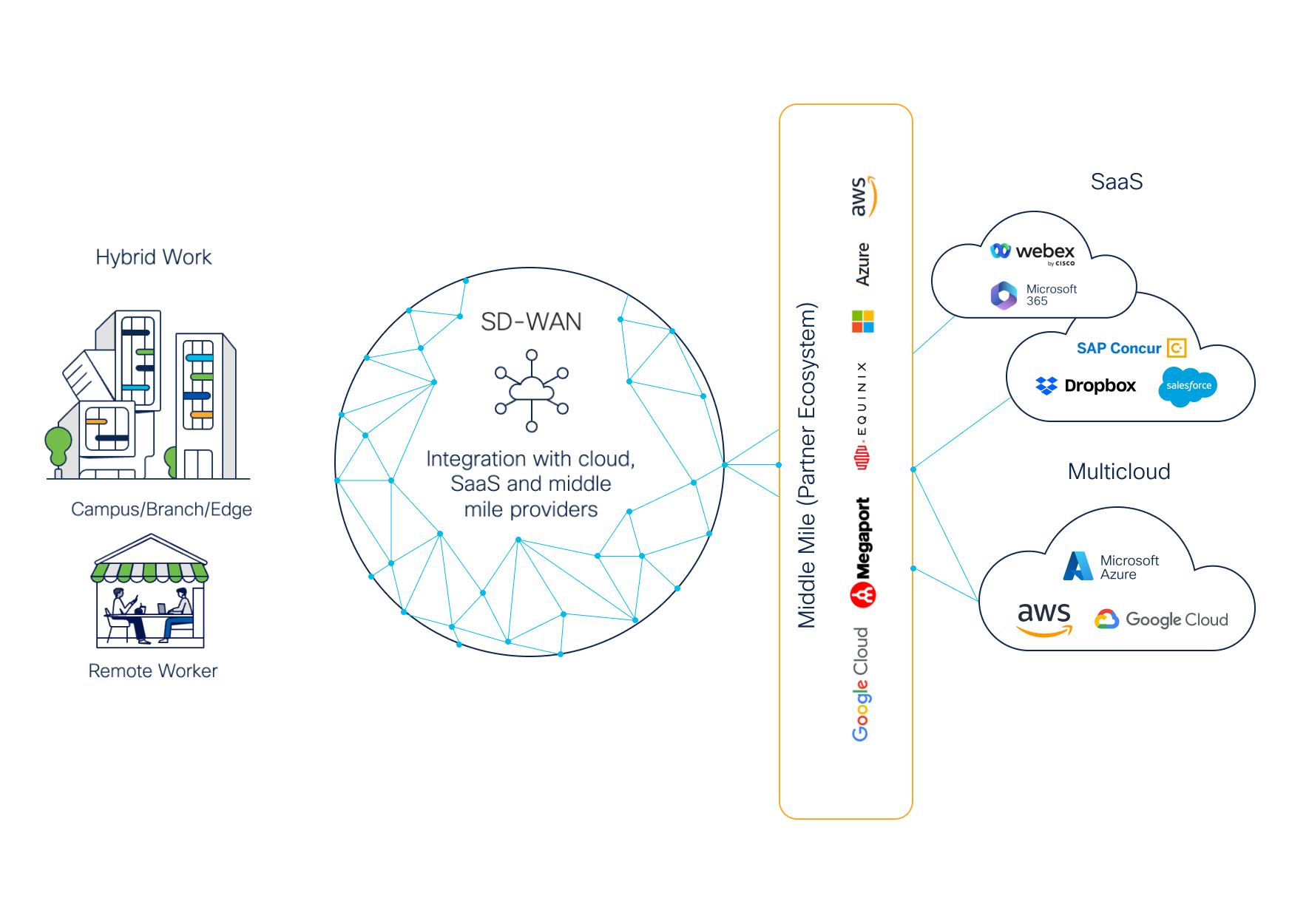
The middle mile is the long-haul transport layer that has grown in complexity with the migration to the cloud. It serves as the connective tissue between first and last mile, interconnecting different types of cloud services, cloud applications (e.g., SaaS, IaaS), and data centers. Specialized middle-mile providers like Equinix and Megaport provide cross-connects between business networks, the internet, and cloud providers globally. Adding to the array of choices in the middle mile, public cloud providers like AWS, Google Cloud, and Microsoft Azure offer customers the ability to access their apps with site-to-cloud, site-to-site, region-to-region, cloud-to-cloud, and other connection options with different quality of experience metrics.  

The last mile is the connection between the data center or service provider and the end user’s device and application.    

Managing multicloud complexity with SD-WAN integrations  

Using applications distributed across multiple clouds and SaaS, workers have widely different experiences depending on their location. Adverse and unpredictable amounts of downtime, latency, and speed, for example, can threaten business continuity. So, establishing reliable, consistent, high-quality experiences is very much on the minds of enterprise IT managers today. 

More than half (53%) of respondents to the 2023 Global Networking Trends Report said they are prioritizing integration with cloud providers to improve connectivity to cloud-based apps from distributed locations. Additionally, 49% said they are using SD-WAN integrations across providers and multiple clouds to provide a simpler, consistent, optimized, and secure IT and application experience. 

SD-WAN unifies the entire WAN backbone and brings secure, private, cloud-aware connectivity that is agnostic to all kinds of link types, providers, and geographies (Figure 2).  

Figure 2. SD-WAN integrations with IaaS, SaaS, and middle-mile providers are vital for a better IT and user experience 

With SD-WAN providing connectivity between cloud, SaaS, and middle-mile providers, real-time traffic steering based on centralized policy and end-to-end analytics is possible. Network admins can be proactive instead of reactive, changing traffic parameters on demand, according to application, congestion, location, user, device, and other factors. 

SD-WAN multicloud integrations in action 

Tamimi Markets, a major Saudi Arabian supermarket chain, was having trouble providing a consistent experience to users at markets, warehouses, branch offices, and remote locations. Dependent on three ISPs for end-to-end connectivity in a hub-and-spoke architecture, they moved to a cloud architecture to eliminate the need to backhaul network traffic through the headquarters and in the process quadrupled bandwidth speeds. An integrated SD-WAN enables them to steer their traffic over a variety of link options based on network demand, cost, and quality of experience metrics.  

Asian food manufacturer Universal Robina Corporation shifted to a multicloud architecture to support remote workers after the pandemic. It uses SD-WAN to connect users and apps to its multicloud architecture securely, wherever they are located. The multicloud integrations enable secure connectivity from branches to the Microsoft Azure cloud and with Microsoft 365 for a superior application experience with informed network routing (INR) that enables the exchange of telemetry between Cisco and Microsoft while providing full visibility to Universal Robina’s IT team. 

Foundational for a SASE architecture 

Another benefit of SD-WAN is that it is one half of a converged secure access service edge (SASE) architecture. SASE radically simplifies security and networking through unified and centralized management to connect users to applications in complex and highly distributed environments. By combining SD-WAN networking infrastructure and routing traffic through a cloud-centric security service edge (SSE) solution, companies can maintain the same level of security for cloud users as data center users (Figure 3). 

Figure 3. SD-WAN is foundational to a SASE architecture 

It’s a multicloud world and SD-WAN―with tight integrations to leading cloud, SaaS, and middle-mile providers―is the connective tissue from first mile to last, managing complexity and driving agility throughout sprawling multicloud environments.

What’s more, SD-WAN multicloud integrations bring together each organization’s many different types of transport connections and policies under one management system for secure, consistent service.

The cost savings from automation and the ability to steer traffic on demand with optimized routing are further compelling reasons why SD-WAN continues to grow in popularity. Once established, these features enable IT departments to build an optimized global network in a simplified, fully automated way, within hours. 

Watch the Global Networking Trends on-demand webinar:

Securely connect people, places, and things in an ever-changing world

Share

  With tight integrations to leading cloud, SaaS, and middle-mile providers, SD-WAN multicloud integration is an antidote to the management complexity and lack of agility of sprawling multicloud environments.  Read More Cisco Blogs 

By |2023-08-23T00:51:50+00:00August 23, 2023|Cisco: Learning|0 Comments

Cisco CX Helps Trident Technical College Deliver Secure Educational Services James Turrell on August 22, 2023 at 1:26 pm

One of my favorite things I get to do in my role at Cisco is talk about our amazing customers. In fact, I usually get the honor of writing the blog about our CX Customer Hero Award Winners at events… Read more on Cisco Blogs

One of my favorite things I get to do in my role at Cisco is talk about our amazing customers. In fact, I usually get the honor of writing the blog about our CX Customer Hero Award Winners at events like Cisco Live 2023 a few weeks back.

Being able to celebrate our customers’ successes is always a highlight at events, but customer innovation, hard work, and engagement with Cisco Customer Experience (CX) aren’t limited to just a handful of big events each year. Those efforts continue around the clock, every day of the year.

I also have the honor of leading a team of professionals who identify customers with amazing stories; engage with those customers; and publish a wealth of incredible CX customer stories throughout the year. With that in mind, I am going to share many of these stories with you, between our large customer events.

First up is a recent story from Trident Technical College in South Carolina. As the largest technical college in the state, Trident Technical College has nearly 12,000 students enrolled each year. Former student, and current CIO of Trident Technical College, MG Mitchum was looking to provide secure, accessible, and innovative educational services. He and his team worked with Cisco Services to provide a seamless experience for students to access data and learn more effectively.

I can go on about it, as it’s a great story, but I cannot tell it any better than MG Mitchum himself. I encourage you to take a moment and hear what the CIO had to say about working with the Cisco Services team.

As you saw, Trident Technical College needed to provide a secure network experience for students. They had a limited set of resources, including IT staff, and they still needed to deploy new technologies without disrupting service. The CX team was able to help Trident Technical College with those challenges, and most importantly, they helped the college maximize its investment in Cisco products they already owned. If you would like to see the full suite of Cisco solutions used in this story, you can get more details on our “Securely delivering education at Trident Technical College” story page.

Of course, this is just one selected highlight from all the great CX customer stories I get to see regularly. To explore more of our customer stories, please visit our Customer Stories Index – a catalog of stories highlighting how Cisco services customers are transforming and innovating to drive impact in their organizations and across the world. I’ll continue to pick some of these to feature along the way.

More importantly, if you are interested in sharing your own customer story, connect with us at cxcustomerstories@cisco.com. We’d love to hear from you. Stay tuned and follow @CiscoCX on Twitter for more CX updates.

Don’t have a story to tell just yet? Our team can help you build it, along with your network.

Share

  Join us in celebrating one of the latest CX Customer Stories. Trident Technical College was able to provide secure, accessible, and innovative educational services by working with Cisco Services to provide a seamless experience for students to access data and learn more effectively.  Read More Cisco Blogs 
By |2023-08-23T00:51:50+00:00August 23, 2023|Cisco: Learning|0 Comments
Go to Top