About (Edit profile)

This author has not yet filled in any details.
So far has created 1829 blog entries.

Building Data Center Infrastructure for the AI Revolution  Kevin Wollenweber on March 19, 2024 at 3:00 pm

This is part two of a multi-part blog series on AI. Part one, Why 2024 is the Year of AI for Networking, discussed Cisco’s AI networking vision and strategy. This blog will focus on evolving data cen… Read more on Cisco Blogs

​[[{"value":"

This is part two of a multi-part blog series on AI. Part one, Why 2024 is the Year of AI for Networking, discussed Cisco’s AI networking vision and strategy. This blog will focus on evolving data center network infrastructure for supporting AI/ML workloads, while the next blog will discuss the Cisco compute strategy and innovations for mainstreaming AI.

As discussed in part one of the blog series, Artificial intelligence (AI) and machine learning (ML) have recently experienced a steep investment trajectory recently, catapulted by generative AI. This has opened up new opportunities to deliver actionable insights and real-world problem-solving capabilities.

Generative AI requires a significant amount of processing power and higher networking performance to deliver outcomes rapidly. Hyperscalers have led the AI revolution with mass-scale infrastructure using thousands of graphics processing units (GPUs) to process petabytes of data for AI workloads, such as training models. Many organizations, including enterprise, public sector, service providers, and Tier 2 web-scalers, are exploring or starting to use generative AI with training and inference models.

To process AI/ML workloads or jobs that involve large data sets,  it is necessary to distribute them across multiple GPUs in an AI/ML cluster. This helps balance the load through parallel processing and deliver high-quality results quickly. To achieve this, it is essential to have a high-performance network that supports non-blocking, low-latency, lossless fabric. Without such a network, latency or packet drops can cause learning jobs to take much longer to complete, or may not complete at all. Similarly, when running AI inferencing in edge data centers, it is vital to have a robust network to deliver real-time insights to a large number of end-users.

Why Ethernet?

The foundation for most networks today is Ethernet, which has evolved from use in 10Mbps LANs to WANs with 400GbE ports. Ethernet’s adaptability has allowed it to scale and evolve to meet new demands, including those of AI. It has successfully overcome challenges such as scaling past DS1, DS3, and SONET speeds, while maintaining the quality of service for voice and video traffic. This adaptability and resilience have allowed Ethernet to outlast alternatives such as Token Ring, ATM, and frame relay.

To help improve throughput and lower compute and storage traffic latency, the remote direct memory access (RDMA) over Converged Ethernet (RoCE) network protocol is used to support remote access to memory on a remote host without CPU involvement.  Ethernet fabrics with RoCEv2 protocol support are optimized for AI/ML clusters with widely adopted standards-based technology, easier migration for Ethernet-based data centers, proven scalability at lower cost-per-bit, and designed with advanced congestion management to help intelligently control latency and loss.

According to the Dell’oro Group, AI networks will act as a catalyst to accelerate the transition to higher speeds. Market demand from “Tier 2/3 and large enterprises are forecast to be significant, approaching $10 B over the next five years,” and they are expected to prefer Ethernet.

Why Cisco AI infrastructure?

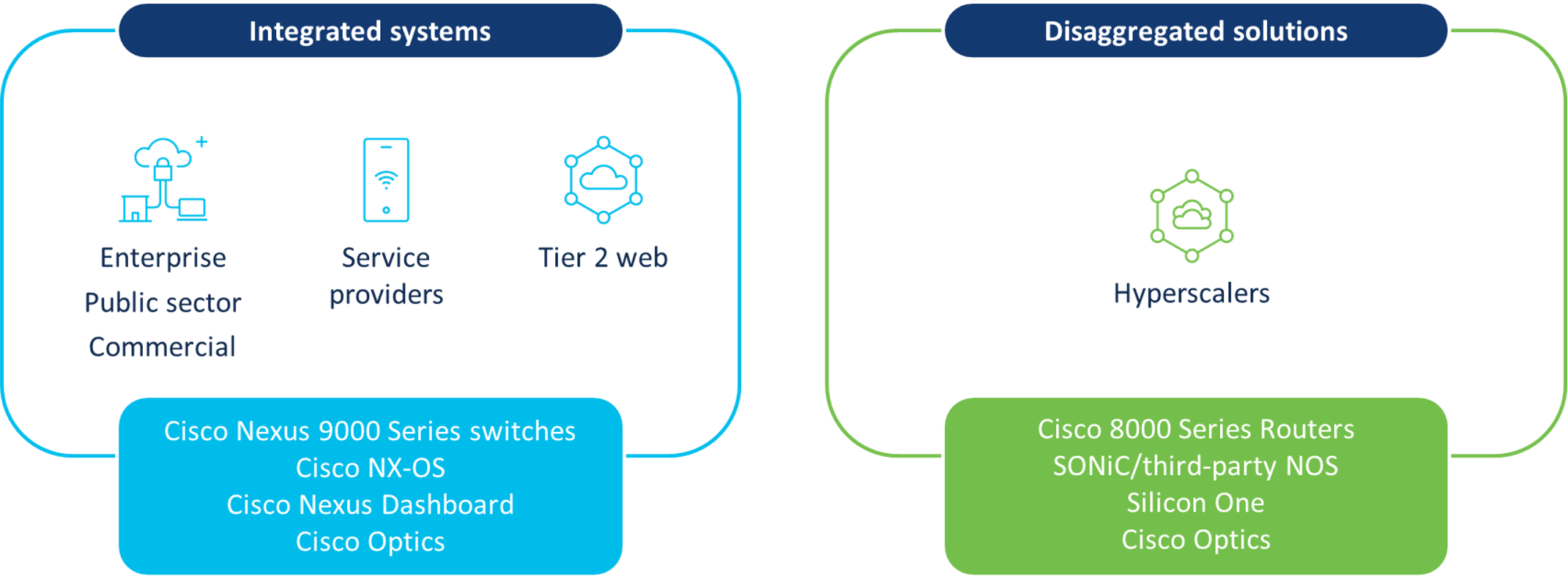
We have made significant investments in our data center networking portfolio for AI infrastructure across platforms, software, silicon, and optics. This include Cisco Nexus 9000 Series switches, Cisco 8000 Series Routers, Cisco Silicon One, network operating systems (NOSs), management, and Cisco Optics (see Figure 1).

Figure 1. Cisco AI/ML data center infrastructure solutions

This portfolio is designed for data center Ethernet networks transporting AI/ML workloads, such as running inference models on Cisco unified computing system (UCS) servers. Customers need choices, which is why we are providing flexibility with different options.

Cisco Nexus 9000 Series switches are integrated solutions that deliver high-throughput and provide congestion management to help reduce latency and traffic drops across AI/ML clusters. Cisco Nexus Dashboard helps view and analyze telemetry, and can help quickly configure AI/ML networks with automation, including congestion parameters, ports, and adding leaf/spine switches. This solution provides AI/ML ready networks for customers to meet the key requirements, with a blueprint for network infrastructure and operations.

Cisco 8000 Series Routers support disaggregation for data center use cases requiring high-capacity open platforms using Ethernet—such as AI/ML clusters in the hyperscaler segment. For these use cases, the NOS on the Cisco 8000 Series Routers can be third-party or Software for Open Networking in the Cloud (SONiC), which is community-supported and designed for customers needing an open-source solution. Cisco 8000 Series Routers also support IOS XR software for other data center routing use cases, including super-spine, data center interconnect, and WAN.

Our solutions portfolio leverages Cisco Silicon One, which is Cisco chip innovation based on a unified architecture that delivers high-performance with resource efficiency. Cisco Silicon One is optimized for latency control with AI/ML clusters using Ethernet, telemetry-assisted Ethernet, or fully scheduled fabric. Cisco Optics enable high throughput on Cisco routers and switches, scaling up to 800G per port to help meet the demands of AI infrastructure.

We are also helping customers with their budgetary and sustainability goals through hardware and software innovation. For example, system scalability and Cisco Silicon One power efficiency help reduce the amount of resources required for AI/ML interconnects. Customers can access network visibility into actual usage of power and carbon footprint such as KWh, cost, and CO2 emissions via Cisco Nexus Dashboard Insights.

With this AI/ML infrastructure solutions portfolio, Cisco is helping customers deliver high-quality experiences for their end-users with fast insights, through sustainable, high-performance AI/ML Ethernet fabrics that are intelligent and operationally efficient.

Is my data center ready to support AI/ML applications?

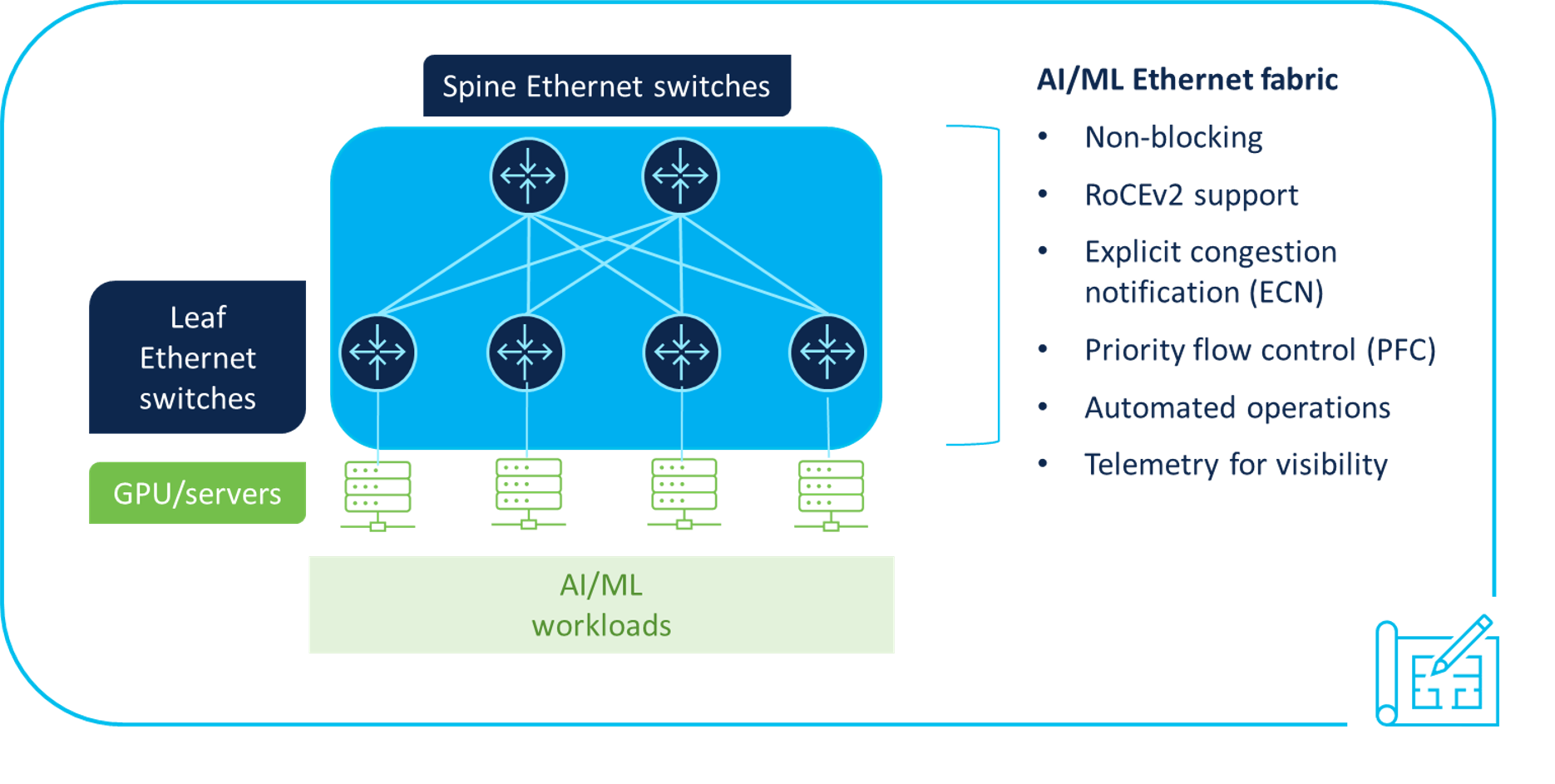
Data center architectures need to be designed properly to support AI/ML workloads. To help customers accomplish this goal, we applied our extensive data center networking experience to create a data center networking blueprint for AI/ML applications (see Figure 2), which discusses how to:

Build automated, scalable, low-latency, Ethernet networks with support for lossless transport, using congestion management mechanisms such as explicit congestion notification (ECN) and priority flow control (PFC) to support RoCEv2 transport for GPU memory-to-memory transfer of information.
Design a non-blocking network to further improve performance and enable faster completion rates of AI/ML jobs.
Quickly automate configuration of the AI/ML network fabric, including congestion management parameters for quality-of-service (QoS) control.
Achieve different levels of visibility into the network through telemetry to help quickly troubleshoot issues and improve transport performance, such as real-time congestion statistics that can help identify ways to tune the network.
Leverage the Cisco Validated Design for Data Center Network Blueprint for AI/ML, which includes configuration examples as best practices on building AI/ML infrastructure.

Figure 2. Cisco AI data center networking blueprint

How do I get started?

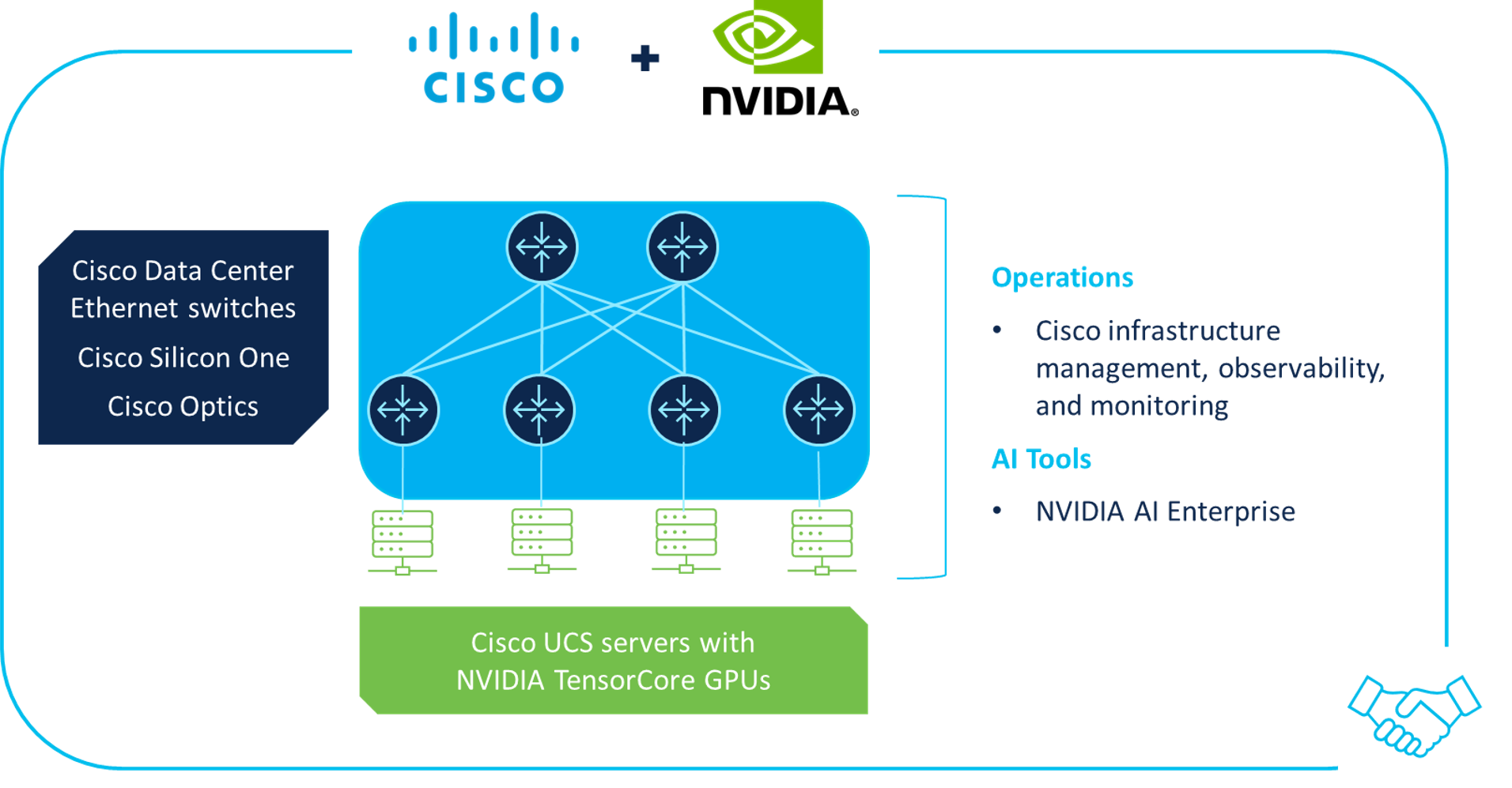
Evolving to a next-gen data center may not be straightforward for all customers, which is why Cisco is collaborating with NVIDIA® to deliver AI infrastructure solutions for the data center that are easy to deploy and manage by enterprises, public sector organizations, and service providers (see Figure 3).

Figure 3. Cisco/NVIDIA partnership

By combining industry-leading technologies from Cisco and NVIDIA, integrated solutions include:

Cisco data center Ethernet infrastructure: Cisco Nexus 9000 Series switches and Cisco 8000 Series Routers, including Cisco Optics and Cisco Silicon One, for high-performance AI/ML data center network fabrics that control latency and loss to enable better experiences with timely results for AI/ML workloads
Cisco Compute: M7 generation of UCS rack and blade servers enable optimal compute performance across a broad array of AI and data-intensive workloads in the data center and at the edge
Infrastructure management and operations: Cisco Networking Cloud with Cisco Nexus Dashboard and Cisco Intersight, digital experience monitoring with Cisco ThousandEyes, and cross-domain telemetry analytics with the Cisco Observability Platform
NVIDIA Tensor Core GPUs: Latest-generation processors optimized for AI/ML workloads, used in UCS rack and blade servers
NVIDIA BlueField-3 SuperNICs: Purpose-built network accelerators for modern AI workloads, providing high-performance network connectivity between GPU servers
NVIDIA BlueField-3 data processing units (DPUs): Cloud infrastructure processors for offloading, accelerating, and isolating software-defined networking, storage, security, and management functions, significantly enhancing data center performance, efficiency, and security
NVIDIA AI Enterprise: Software frameworks, pretrained models, and development tools, as well as new NVIDIA NIM microservices, for more secure, stable, and supported production AI
Cisco Validated Designs: Validated reference architectures designed help to simplify deployment and management of AI clusters at any scale in a wide range of use cases spanning virtualized and containerized environments, with both converged and hyperconverged options
Partners: Cisco’s global ecosystem of partners can help advise, support, and guide customers in evolving their data centers to support AI/ML applications

Leading the way

Cisco’s collaboration with NVIDIA goes beyond selling existing solutions through Cisco sellers/partners, as more technological integrations are planned. Through these innovations and working with NVIDIA, we are helping enterprise, public sector, service provider and web-scale customers on the data center journeys to fully enabled AI/ML infrastructures, including for training and inference models.

We’ll be at NVIDIA GTC, a global AI conference running March 18–21, so visit us at Booth #1535 to learn more.

In the next blog of this series, Jeremy Foster, SVP/GM, Cisco Compute, will focus on the Cisco Compute strategy and innovations for mainstreaming AI.

Share

"}]]  Cisco is helping enterprises, public sector organizations, and communication service/cloud providers evolve data center networks to support AI/ML applications using Ethernet. With an AI/ML networking blueprint and a new strategic partnership with NVIDIA, Cisco is providing data center Ethernet networking solutions for customers to enable AI/ML workloads.  Read More Cisco Blogs 

By |2024-03-19T19:53:17+00:00March 19, 2024|Cisco: Learning|0 Comments

Cisco’s Bill Davenport Starts Term on FCC Technological Advisory Council Waldo McMillan on March 19, 2024 at 3:04 pm

Today, the Federal Communications Commission’s (FCC) Technological Advisory Council (TAC) held its first meeting, with Cisco Senior Director of Technology and Spectrum Policy Bill Davenport serving… Read more on Cisco Blogs

​[[{"value":"

Today, the Federal Communications Commission’s (FCC) Technological Advisory Council (TAC) held its first meeting, with Cisco Senior Director of Technology and Spectrum Policy Bill Davenport serving on the council after being appointed by FCC Chairwoman Jessica Rosenworcel in February.  

The TAC will provide technical expertise to the FCC to identify important areas of innovation and develop informed technology policies supporting the United States’ competitiveness in the global economy, including as it relates to U.S. spectrum leadership. 

“Collaboration between public and private sectors is fundamental in addressing the critical issues that shape our digital world, and the advisory council is a testament to the value of this partnership. I am eager to contribute to this group’s collective efforts and impactful solutions that drive progress and opportunity around technology.” – Bill Davenport, Sr. Director, Technology and Spectrum Policy

The TAC will consider and advise the FCC on efforts to facilitate U.S. spectrum leadership; study advanced spectrum sharing techniques, including the implementation of artificial intelligence and machine learning to improve the utilization and administration of spectrum; and other emerging technologies. 

“Charting the course of connectivity from 5G to 6G and harnessing the transformative power of AI for spectrum efficiency are imperative for policy innovation. Cisco’s commitment to these goals sets the stage for America’s competitive edge and technological leadership globally. I am thrilled that Bill will contribute to this mission as part of the FCC’s Technological Advisory Council.” – Waldo McMillan, VP, The Americas, Government Affairs

The TAC, established in 1998, is organized under the authority of the Federal Advisory Committee Act to focus on key issues affecting the development of emerging communications technologies and comprises a diverse array of leading experts

Share

"}]]  Today, the Federal Communications Commission’s (FCC) Technological Advisory Council (TAC) held its first meeting, with Cisco Senior Director of Technology and Spectrum Policy Bill Davenport serving on the council after being appointed by FCC Chairwoman Jessica Rosenworcel in February.   The TAC will provide technical expertise to the FCC to identify important areas of innovation and  Read More Cisco Blogs 

By |2024-03-19T19:53:17+00:00March 19, 2024|Cisco: Learning|0 Comments

Cisco Launches CCST IT Support Certification: Your Pathway to a Career in IT Joe Clarke on March 19, 2024 at 5:21 pm

Have you ever considered pursuing a career in information technology (IT) or IT support but found yourself unsure of where to start? I know how you feel; I started my career at Cisco in the Technical… Read more on Cisco Blogs

​[[ Facebook ]]  Introducing the Cisco Certified Service Technician (CCST) IT Support, a new entry-level Cisco certification that validates the knowledge required for entry-level IT support roles.  Read More Cisco Blogs 

By |2024-03-19T19:53:16+00:00March 19, 2024|Cisco: Learning|0 Comments

Five AI topics to discuss with your CEO Eric Knipp on March 18, 2024 at 7:00 pm

AI is the biggest topic of conversation these days. At Cisco Live EMEA in Amsterdam in early February, you couldn’t swing an Ethernet cable without hitting someone who was talking about it. Even t… Read more on Cisco Blogs

​[[{"value":"

AI is the biggest topic of conversation these days. At Cisco Live EMEA in Amsterdam in early February, you couldn’t swing an Ethernet cable without hitting someone who was talking about it. Even though AI comes with especially useful applications and some very practical downsides, it’s important to know how to frame the conversation with your CIO or CEO before your company invests in it.

Here are five things to think about as you’re weighing the conversation possibilities:

Determine your AI strategy

Many of you might be asking what your company’s AI strategy is so you can better inform your employees, customers, partners, etc. But in truth, you should ask what existing functions within your company can be improved by AI. The right question involves how AI complements existing functions versus how AI serves as an overlay strategy. For example, “what is our customer service strategy enabled through AI?” or “what is our R&D strategy enabled by AI?”

Consider partnering for AI capabilities

Since 2015 Cisco has been a strategic partner with NVIDIA, the inventor of the GPU that fueled the AI boom. We are combining our expertise in Ethernet networking and our extensive partner ecosystem with NVIDIA’s GPU technology to help customers navigate AI transitions with highly secure Ethernet-based infrastructure. Cisco already has NVIDIA’s GPUs inside our Collaboration portfolio. And now we’re expanding that capability into the data center. Recently Cisco and NVIDIA announced an enterprise AI workload solution—we’re putting NVIDIA’s GPUs into our UCS servers and wrapping them with Cisco Validated Designs (CVDs) to make it easier for enterprises to easily deploy and manage their own secure AI infrastructure. Essentially, we’re creating AI superpowered networks.

Know that your employees are already using AI

It’s the wild west out there and employees are naturally curious about trying AI using programs such as ChatGPT. So, companies need to be very intentional about the policies they put in place to protect their IP internally. At Cisco, we tell our employees not to use public AI services. Instead, we have developed our own internal AI capabilities that leverage our ecosystem partners and our own internal developed capabilities in platforms like Webex. Many companies have blocked employees from using AI services on their corporate network all together.

If you can’t say no wholesale, at least give employees an AI alternative. Just like with security, if you make it hard to find a good tool, employees may rely on shadow IT to download the tools they want. Give them an AI alternative that is backed up by your own internal policies and InfoSec protections. Cisco recently launched Motific, our first SaaS product that allows for trustworthy GenAI deployments in organizations. Motific provides a central view across the entire GenAI journey to help central IT and security teams deliver trustworthy GenAI capabilities securely and responsibly across their organization.

Show how AI ties to your core business

Let’s face it—AI is expensive and requires more technology investment. For example, Reuters estimates that a ChatGPT search costs 10x more than a standard Google or Microsoft search. In this economy, companies are protecting their core business right now and not taking on projects outside their IT budgets. If you can show that AI is going to help your core business generate revenue, fuel growth, reduce risk, reduce costs, or better utilize resources, then it will get funded. But if you can’t, it will get shot down.

Be creative with your AI training and hiring

We’re experiencing a massive skills and resourcing gap in the IT space. In particular, there are nine to ten jobs available for every skilled professional just in the Security space. Since AI is a brand-new skill set, many industry companies are looking to college students or “early in career” candidates to fill these positions. But AI can be learned by people who don’t necessarily have a four-year degree.

In fact, some of our customers are utilizing Cisco Networking Academy to recruit people who aren’t traditional college students. For example, DOD SkillBridge – an amazing program sponsored by the Department of Defense – helps veterans transition out of the military directly into corporate America. For the first six months, they serve as interns for that corporation, funded by DOD SkillBridge, to learn new skills. These veterans are highly motivated and skilled people who perform well under pressure, and many of them already have experience in networking, cybersecurity, AI, and logistics. Through SkillBridge, Cisco has recruited more than 120 veterans in the last two years. It’s an amazing way to give these people an opportunity to enter the workforce using a low-risk, high-success model.

In closing

While there are seemingly hundreds of decisions to make about AI, the wisest course of action is to start conservatively. Determine what AI tools are (or are not) OK for your employees to use. Begin with internal AI projects that you can control to protect your IP. If you can’t develop or buy AI technology, consider partnering with another company who can provide it. Ensure you have the right employees with skillsets to understand and manage it. Then see how AI can be applied to improve both your employee experience, your customer experience, and your company profile.

Register to see a panel discussion presented by World Wide Technology (WWT)

Industry Perspective to Inform AI Investment Strategies

Hosted by WWT’s Chris Campbell, this panel discussed “Moving Toward AI Adoption.” Speakers included:

Eric Knipp, VP, Solutions Engineering, Global Specialists for Cisco Systems, IncTravis Palena, Global Channel Sales Director for Data Center and AI, IntelParas Kikani, Senior Director of Solutions Engineering at NetApp

Share

"}]]  Artificial Intelligence (AI) comes with both useful applications and some very practical downsides, so it’s important to know how to frame the conversation with your CIO or CEO before your company invests in it.  Read More Cisco Blogs 

By |2024-03-19T05:51:45+00:00March 19, 2024|Cisco: Learning|0 Comments

Sign up for a Tour at the RSA Conference 2024 SOC Jessica Bair on March 18, 2024 at 12:00 pm

Join the guided tour outside the Security Operations Center, where we’ll discuss real time network traffic of the RSA Conference, as seen in the NetWitness platform. Engineers will be using Cisco S… Read more on Cisco Blogs

​[[{"value":"

Join the guided tour outside the Security Operations Center, where we’ll discuss real time network traffic of the RSA Conference, as seen in the NetWitness platform. Engineers will be using Cisco Security Cloud in the SOC, comprised of Cisco Breach Protection Suite, User Protection Suite, Cloud Protection Suite and Secure Firewall. Incidents are investigated with Threat Intelligence, provided by Cisco Talos, partners Recorded Future, alphaMountain, Pulsedive and community sources. 

Outside the SOC, you will receive a security briefing and have time for Q&A with Cisco and NetWitness engineers. An Expo Pass is all that is required to join the tour

Advanced registration is highly recommended. Below are the available tour times. Please fill out the RSAC SOC Tour Request Form to request your spot. SOC Tours Offered Mon-Thurs: 

Monday, May 6 (Private Tour) 

2:00pm

Tuesday, May 7 (Private Tour) 

2:00pm

Unable to make these time slots? Join us for one of our public tours

Please meet at the Cisco Threat Wall, in between north and south hall, ten minutes before your tour time, where a Cisco team member will escort the group to the SOC. 

Also, plan to attend the official out briefing on the security observations, at the session EXPOSURE: The 5th Annual RSAC SOC Report, 9 May 2024, 1:40PM – 50 Minutes, Moscone West. (Full Conference pass required) 

We’d love to hear what you think. Ask a Question, Comment Below, and Stay Connected with Cisco Security on social!

Cisco Security Social Channels

InstagramFacebookTwitterLinkedIn

Share

"}]]  Join the guided tour outside the Security Operations Center, where we’ll discuss real time network traffic of the RSA Conference.  Read More Cisco Blogs 
By |2024-03-18T17:51:21+00:00March 18, 2024|Cisco: Learning|0 Comments

Splunk Joins Cisco: Our Partner Ecosystems Just Got Even Stronger Rodney Clark on March 18, 2024 at 2:00 pm

What do you get when you combine the full power of the network with market-leading security and observability solutions? More customer value and an amazing partner ecosystem.

It’s official! Today, w… Read more on Cisco Blogs

​[[{"value":"

What do you get when you combine the full power of the network with market-leading security and observability solutions? More customer value and an amazing partner ecosystem.

It’s official! Today, with the closing of the acquisition, Splunk became part of Cisco. We’re looking forward to this exciting new chapter of our journey together – and it couldn’t have come at a better time.

Delivering Greater Customer Value Together

In today’s digital world, organizations need to connect the people, places, apps, data, and devices that power their business, while protecting their entire digital footprint from cybersecurity threats, downtime, and other business risks. Together, we’re revolutionizing the way our customers leverage data to connect and protect every aspect of their organizations – and we’ll be doing it with our incredible partners.

How? Through:

Better Security. A highly comprehensive security solution for threat prevention, detection, investigation, and response for organizations of any size, utilizing cloud, network, and endpoint traffic for unparalleled visibility.
Better Observability. A highly comprehensive full-stack observability solution for delivering amazing digital experiences across a multi-cloud hybrid environment.
Better Networking. A leading secure networking solution delivered on intelligent, resilient, and continually optimized network infrastructure.
Better AI. Cisco’s networking portfolio – combined with enhanced security, full-stack observability, and a comprehensive data platform – empowers customers to securely harness the power of AI throughout their organizations and applications.
Better Economics. Cisco and Splunk’s platform approach will help our customers consolidate numerous point products—delivering better business outcomes and reducing costs.

Delivering Greater Partner Value

Whether you’re a Splunk partner or Cisco partner or both, you may be wondering what this means for you and your organization.

Splunk partners now form an essential part of Cisco’s global partner ecosystem.
We believe partners across this unified ecosystem can benefit from the innovation, differentiation, and opportunity for profitable growth resulting from our companies – and partner communities – coming together.
Collectively, we have an opportunity to deliver unique experiences and high-value services for our customers by working together in new ways.

For now, it’s business as usual. As our partners’ success is our top priority, we’re balancing the need to quickly bring the benefits of our combined capabilities to our partners while ensuring a great experience. We’ll be sharing more information in the coming months as we bring our organizations together.

Meanwhile, we invite you to join us April 4 at 10 a.m. Pacific Time for an Executive Roundtable on the Future of Cisco and Splunk livestreamed on Cisco.com. Learn more about our joint vision, and register for the Roundtable.

Thank you for your continued partnership, and we look forward to this exciting new chapter in our journey together.

Rodney and Gretchen

Learn more about our joint vision here! 

We’d love to hear what you think. Ask a Question, Comment Below, and Stay Connected with #CiscoPartners on social!

Cisco Partners Facebook  |  @CiscoPartners X/Twitter  |  Cisco Partners LinkedIn

Share

"}]]  It’s official! Today, with the closing of the acquisition, Splunk became part of Cisco – and it couldn’t have come at a better time.  Read More Cisco Blogs 
By |2024-03-18T17:51:21+00:00March 18, 2024|Cisco: Learning|0 Comments

A New Day for Data: Cisco and Splunk Chuck Robbins on March 18, 2024 at 12:30 pm

Today, we are excited to share that Splunk is now officially a part of Cisco. This means, starting now, our customers will begin to see the benefits of the power of our technologies coming together… Read more on Cisco Blogs

​[[{"value":"

Today, we are excited to share that Splunk is now officially a part of Cisco. This means, starting now, our customers will begin to see the benefits of the power of our technologies coming together to not only solve many of their most complex challenges, but also enable tremendous opportunities. Cisco – supercharged by Splunk – will bring the full power of the network together with market-leading security and observability solutions.

Organizations need to connect the people, places, apps, data, and devices that power their business, and they must protect their entire digital footprint from cybersecurity threats, downtime, and other business risks. This is exactly what we will do.

The combination of Cisco and Splunk will provide unparalleled visibility and insights across an organization’s entire digital footprint, fueled by comprehensive security, observability, and networking solutions. Our customers will be empowered to deliver seamless, secure customer and employee experiences across the physical, digital, and AI-powered worlds.

Better Together: Powering and Protecting the AI Revolution

As one of the largest software companies in the world, we have unparalleled capabilities across AI, security, networking, observability, and data. This will help our customers achieve several business-critical outcomes.

First, we’re going to power the AI revolution. To truly reap the benefits of AI, organizations need the infrastructure to power it, the data to develop it, a security platform to protect it, and an observability platform to monitor and manage it in real time. They also need a trusted, strategic partner by their side every step of the way. With our combined solutions and services, we can ensure our customers are well positioned to win in the era of AI.

Second, we will deliver mission critical security outcomes for our customers to stay ahead of the rapidly evolving threat landscape. Together, we will have highly comprehensive security solutions for threat prevention, detection, investigation, and response for organizations of any size, utilizing cloud, network, and endpoint traffic for unparalleled visibility.

We are thrilled to share a few ways our portfolios will be stronger together. Over the next several months, we intend to incorporate Cisco’s Talos threat intelligence into Splunk, offering our customers access to highly comprehensive threat intelligence to improve threat detection, faster incident response, and a more proactive security strategy. We also intend to unify our AI assistants for security, so security professionals have one common experience when utilizing AI to analyze issues and perform tasks across the combined portfolio. Moving forward, we intend to enable Splunk’s market leading SIEM and SOAR platform to utilize cloud, network, and endpoint analytics available from Cisco’s security portfolio, enabling new ways for customers to detect, investigate, and respond to threats that can only be identified via lateral movement in the network.

Third, we will offer a highly comprehensive full-stack observability solution for delivering amazing digital experiences across multi-cloud hybrid environments. With the most powerful analytics and insights across the entire digital footprint, we will equip our customers with the observability tools to keep their digital systems up and running and avoid costly downtime. We will also begin to deliver a common experience and workflow optimizations across the Cisco and Splunk Observability portfolios. In time, IT and engineering teams can expect AI-driven root cause analysis enhancements and assistants, inclusive of Splunk IT Service Intelligence (ITSI).

Fourth, our customers will now get even more value out of their network. For nearly 40 years, Cisco has built networks which move massive amounts of data every second. Now, by bringing Cisco and Splunk capabilities together, we can harness that data in new and more powerful ways to provide a leading secure networking solution delivered on intelligent, resilient, and continually optimized network infrastructure.

Finally, our combined solutions will help deliver better economics with exceptional value. We believe the market trend towards tool consolidation –– and the convergence of networking, security, and observability –– creates a significant opportunity for Cisco and our customers.

With Cisco and Splunk’s platform approach, we will help our customers consolidate numerous point products—delivering better business outcomes and reducing costs.

Accelerating Innovation with Customers at the Center

While today is a critical step towards the future, it’s the first of many. Our teams have been planning for this moment, and now the deep integration work begins. We are committed to a thoughtful, deliberate, and responsible process. Over the next several months, we will focus on building and delivering best-in-class integrations between Cisco and Splunk products.

At the core of this work is our commitment to offering our customers flexibility and choice in how they access and deploy their data across any on-prem, hybrid, or multi-cloud environment.  We will drive new innovations with a unified data platform that integrates application, fraud, network, multi-cloud, security, user, and other data sources to address cyber, technical, and business risks throughout the entire portfolio. In addition, we will continue our extensive use, support, and contribution to the open source community such as OpenTelemetry, eBPF, and more.

We know that many of our customers value an open approach that benefits their unique technology strategy and we take that perspective to heart. As such, our product portfolio will be open and extensible, with solutions that are tightly integrated, but loosely coupled, enabling us to support our customers’ multi-vendor environments and protect their existing IT investments.

Our Future Together

Today is only the start. While there is so much that makes this day special, perhaps the most important to us is bringing the incredibly talented teams at Cisco and Splunk together.

We both have such pride in the cultures of our two organizations who embody core values that guide us to make the world a safer, more resilient, and more inclusive place. As we move into our next chapter together with Splunk as a part of Cisco, we share an excitement for solving the toughest problems our customers face not only today, but also long into the future. Together, we know we are up for the challenge and look forward to the opportunity to help organizations around the world become more connected and more protected than ever before.

Chuck RobbinsChair & CEO, CiscoGary SteeleEVP & GM, Splunk

Read the Press Release   |  See the Infographic  |  Watch the Video  | About the Acquisition

Forward-Looking Statements
This blog may be deemed to contain forward-looking statements, which are subject to the safe harbor provisions of the Private Securities Litigation Reform Act of 1995. Any statements that are not statements of historical fact (including statements containing the words “will,” “believes,” “plans,” “anticipates,” “expects,” “estimates,” “strives,” “goal,” “intends,” “may,” “endeavors,” “continues,” “projects,” “seeks,” or “targets,” or the negative of these terms or other comparable terminology, as well as similar expressions) should be considered to be forward-looking statements, although not all forward-looking statements contain these identifying words. Readers should not place undue reliance on these forward-looking statements, as these statements are management’s beliefs and assumptions, many of which, by their nature, are inherently uncertain, and outside of management’s control. Forward-looking statements may include statements regarding the expected benefits to Cisco, Splunk and their respective customers from the completed transaction, the integration of Splunk’s and Cisco’s complementary capabilities and products to create an end-to-end platform designed to unlock greater digital resilience for customers, plans for future investment, and our development and use of AI and the role that our innovation plays as our customers adopt AI. Statements regarding future events are based on Cisco’s current expectations, estimates, and projections and are necessarily subject to associated risks related to, among other things, (i) the ability of Cisco to successfully integrate Splunk’s market opportunities, technology, personnel and operations and to achieve expected benefits, (ii) Cisco’s ability to implement its plans, forecasts and other expectations with respect to Splunk’s business and realize expected synergies, (iii) the outcome of any legal proceedings related to the transaction, (iv) the effects on the accounting relating to the acquisition of Splunk, (v) legislative, regulatory, and economic developments, (vi) general economic conditions, and (vii) the retention of key personnel. Therefore, actual results may differ materially and adversely from the anticipated results or outcomes indicated in any forward-looking statements. For information regarding other related risks, see the “Risk Factors” section of Cisco’s most recent report on Form 10-Q filed on February 20, 2024, and its most recent report on Form 10-K filed on September 7, 2023, as well as the “Risk Factors” section of Splunk’s most recent report on Form 10-Q filed with the SEC on November 28, 2023. The parties undertake no obligation to revise or update any forward-looking statements for any reason, except as required by law.
Share

"}]]  Cisco - now supercharged by Splunk - will revolutionize the way customers use data to connect and protect their organizations.  Read More Cisco Blogs 
By |2024-03-18T17:51:21+00:00March 18, 2024|Cisco: Learning|0 Comments
Go to Top